
Group Lockout Box Procedure: Key Control for Maintenance Teams
A group lockout box procedure keeps the keys for equipment isolation locks inside a box that participating workers secure with their own personal locks. The box manages access to those keys; it does not isolate the machine by itself. Before anyone starts servicing, authorized personnel must identify the relevant energy sources, apply the equipment-specific controls, address stored energy, and verify that isolation is effective. This guide explains the key-control workflow, responsibilities, and checks for an industrial maintenance team. Use it to develop questions for your site procedure, rather than as a ready-to-use isolation instruction for an unidentified machine.
The main buying question is therefore not simply how many keys fit inside. It is whether the box, personal locks, isolation locks, and written procedure work together while people join, leave, or change shifts.
What the box controls—and what it cannot control
In a typical lockbox arrangement, equipment locks secure the identified energy-isolating devices. Their operating keys are captured inside the group box. Each participating authorized employee applies an individually assigned personal lock to the box’s designated attachment arrangement. The intended result is that isolation keys remain inaccessible while a participating person’s lock is still attached.
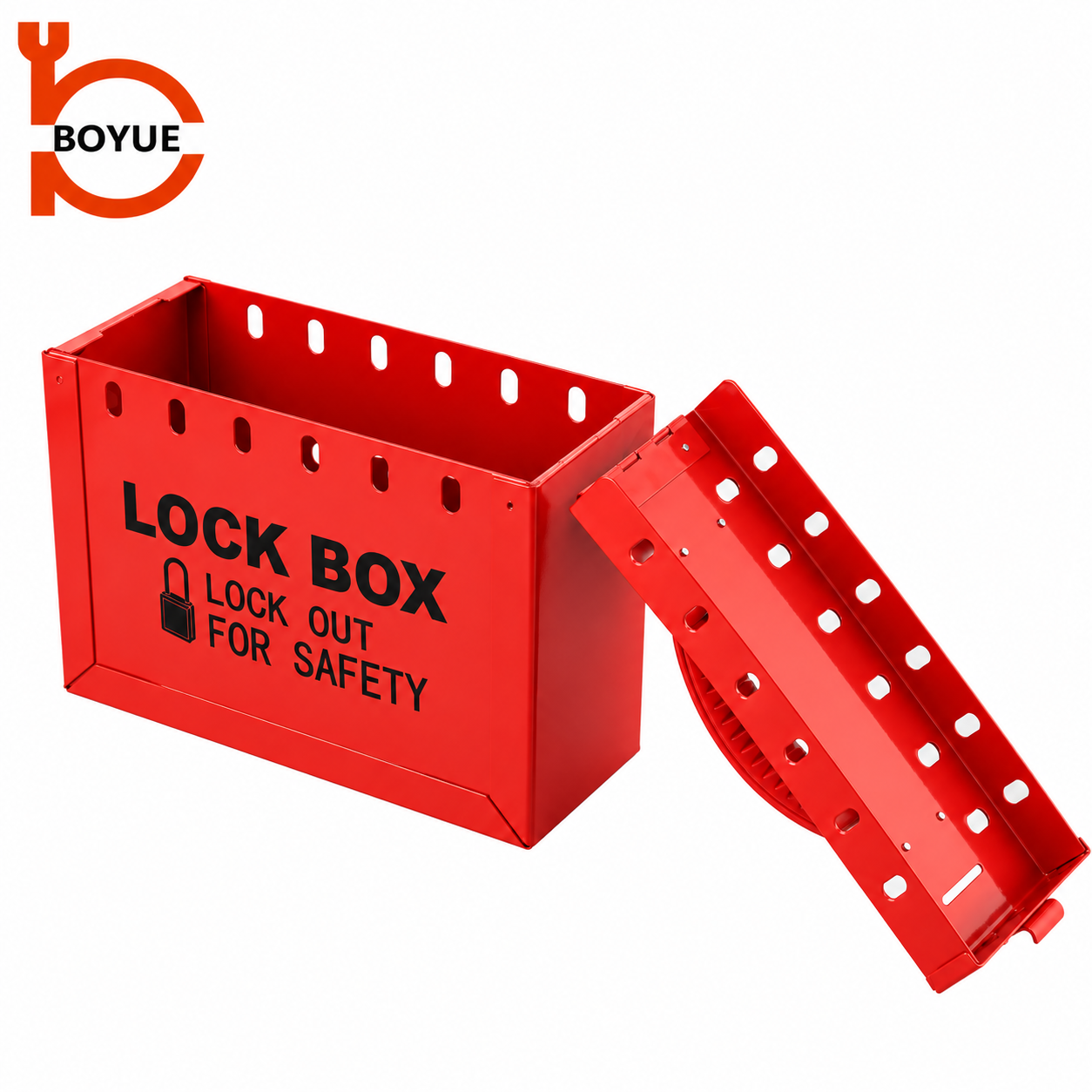
That arrangement depends on the actual lid and latch design. A cabinet that stores spare padlocks is not automatically a group lockout box. Likewise, a slot that allows keys to be inserted does not prove that keys cannot be retrieved through it. Inspect the manufacturer’s instructions and the physical sample before approving a box for the task.
The OSHA group lockout guidance explains the need for protection equivalent to personal lockout and individual participation in the group arrangement. Buying a box does not, by itself, establish that protection.
Separate responsibilities before planning the job
A useful planning exercise is to identify the responsibilities below on a blank job sheet. This is an operational planning aid, not a prescribed regulatory form. The same trained person may perform more than one role when the approved procedure permits it, but the responsibilities should remain clear.
| Role or item | Purpose in the arrangement | Question to settle before work |
|---|---|---|
| Energy-isolating devices and equipment locks | Hold the identified isolation points in their required safe positions | Which exact devices correspond to this machine and work scope? |
| Captured isolation keys | Allow removal of equipment locks after the release process | Have all relevant operating keys been accounted for, including controlled duplicates? |
| Group lockout box | Restrict access to the captured keys while personal locks remain | Does every approved attachment position prevent access with the selected padlocks? |
| Participating authorized employees | Apply and remove their individual personal protection devices | How does each worker confirm participation, understand the isolation, and leave the job? |
| Designated coordinator | Maintain the agreed equipment, crew, and isolation boundaries | Who resolves scope changes and reconciles the job before release? |
For a university example of supporting documentation, see the University of Washington’s group lockout/tagout resource. Your own document should identify the equipment and work boundaries rather than copying a generic example unchanged.
Build the procedure around controlled decision points
1. Define equipment boundaries and the work scope
Identify the machine, connected equipment, and the work that will expose people to hazardous energy. A line name alone may be insufficient when conveyors, auxiliary pumps, accumulators, or upstream systems can affect the task. The approved machine procedure should identify relevant electrical, mechanical, hydraulic, pneumatic, thermal, chemical, gravitational, and other energy hazards as applicable.
Discuss the boundary with operations and every trade involved. If one crew expects the entire production line to be isolated while another has isolated only a local motor, a neat row of locks cannot resolve the disagreement. Stop the planning process until the boundary is explicit.
2. Establish and verify the actual isolation
Authorized personnel carry out shutdown, isolation, lockout, and stored-energy controls using the approved equipment-specific method. Verification must match the hazards and the work. A failed start command alone does not establish electrical absence of voltage, and a pressure gauge alone may not address trapped pressure elsewhere. Electrical testing belongs to qualified personnel following the applicable electrical safety procedures.
The OSHA hazardous energy control standard provides the US general-industry framework for verification, stored energy, coordination, and release. Other rules may apply to particular tasks and jurisdictions. Do not interpret this general article as approval of a specific isolation method.
3. Reconcile isolation locks and captured keys
Use a clear relationship between the isolation record, the equipment locks, and the keys placed inside the box. For example, the record can identify the isolation point and the corresponding lock identifier. That makes a missing key or an unexplained extra lock a question to resolve before work, instead of an end-of-shift surprise.
Keep personal-lock keys under their assigned owners’ control. They are not the keys normally being captured in the group box. Where a facility uses more complex control-lock or nested-box arrangements, document the complete relationship and obtain competent review; avoid improvising an extra layer during the job.
4. Secure individual participation
Before beginning work, each participating authorized employee follows the approved process for understanding the isolation and applying personal protection to the group arrangement. A sign-in list supports coordination, but it should not be treated as a substitute for the required personal device. A coordinator’s lock alone does not represent every person’s individual protection.
Check that the selected personal padlock closes fully through its intended attachment position. Confirm that it cannot simply slide away from the feature it is supposed to restrain. Use only arrangements allowed by the box and lock manufacturers and the site procedure.
5. Control changes during the job
Crews change, tools break, and the repair may reveal a second problem. Define how new participants join the protected arrangement and how departing participants leave it. A roster is useful for identifying who should still be accounted for, but an outdated roster can create false confidence.
If the work scope expands or isolation effectiveness becomes uncertain, suspend the affected work and reassess the controls. Do not assume the existing lockbox covers a new machine merely because the same maintenance team is involved. Similarly, any temporary energization for testing needs its own approved sequence rather than an informal unlocking shortcut.
6. Plan shift transfer before the first shift ends
Prepare an orderly handover that maintains continuity of protection. Record the equipment state, unfinished work, remaining hazards, active isolation points, and responsible personnel. Follow the site’s approved transfer method; do not remove all outgoing personal protection and hope the incoming crew arrives immediately afterward.
Where contractors participate, agree on how the host and contractor energy-control procedures interact. Resolve differences in terminology, identification, and release authority before starting the work.
7. Reconcile the job before returning equipment to service
Each participant normally removes their own personal device when leaving the protected work arrangement. Final release also requires the site procedure’s checks of the work area, equipment condition, personnel location, and notifications. Only after the appropriate release conditions have been met should the captured keys become available for removal of the equipment locks.
A worker’s absence is an exception to manage through a documented process, not permission for routine removal by a supervisor. The box should not encourage shortcuts by making a spare operating key casually available nearby.
Worked planning example: one machine, three workers
Consider a fictional maintenance task involving three authorized workers and several isolation points. This example illustrates the records to reconcile; it does not specify how to isolate any actual machine. The planner prepares an equipment-specific isolation list and identifies the approved box location. The coordinator checks that every relevant equipment-lock key will be captured and that the box can accommodate all personal locks without interference.
Before work begins, the team resolves which person performs each verification and how every participant understands the established controls. During the repair, a fourth worker is requested. That worker completes the approved joining process before entering the hazardous area. If one original worker leaves, their departure is recorded and their personal device is removed under the site’s rules. The remaining workers’ protection stays in place.
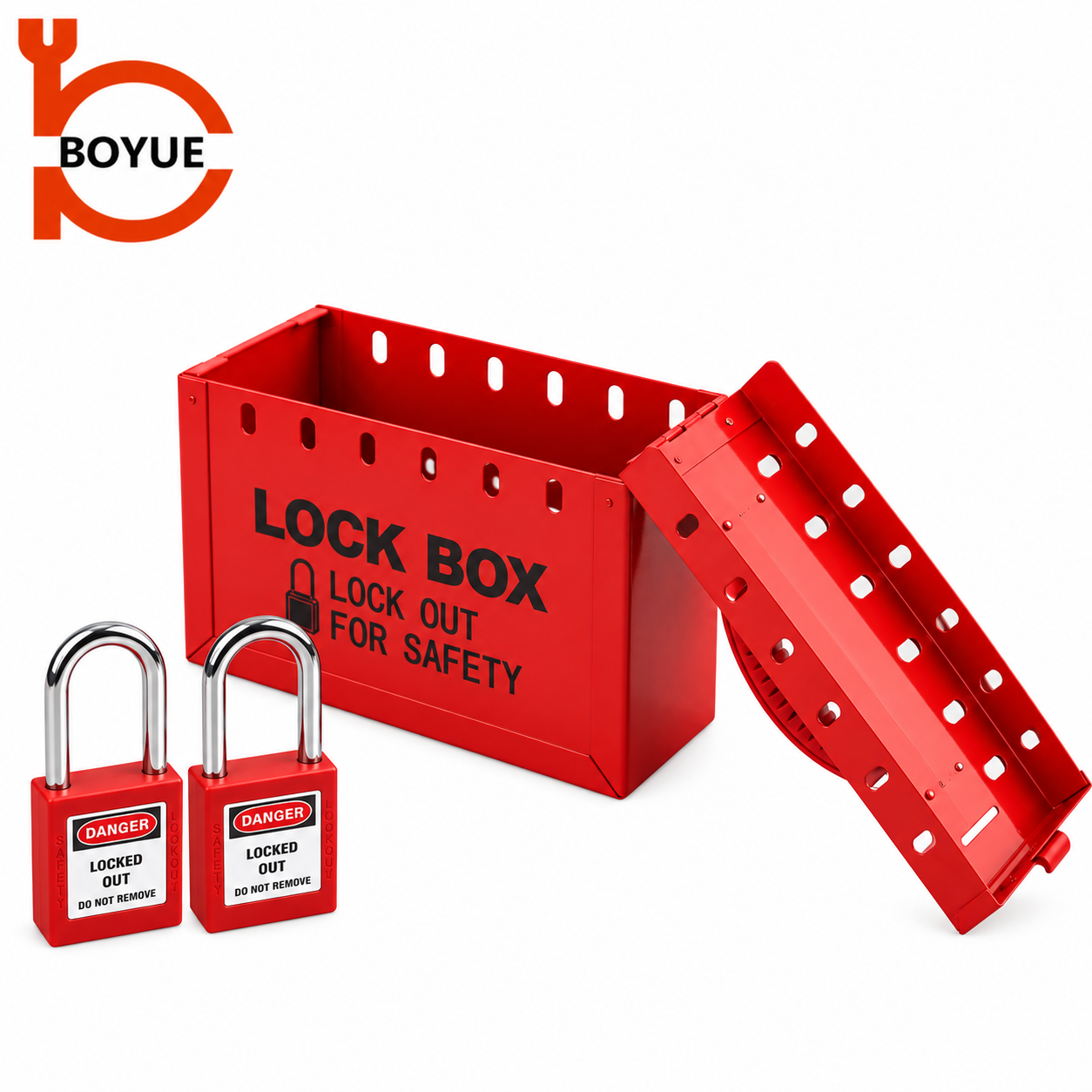
The purchasing lesson is practical: reserve enough usable attachment positions for the actual crew and approved control arrangement. Nominal hole count alone does not confirm that bulky padlocks, tags, gloves, and the chosen lid design work together.
How to evaluate a box before ordering
Start with a physical sample and the intended padlocks. Inspect the lid, closure, attachment openings, key accessibility, finish, carrying arrangement, and identification space. Confirm that a locked attachment position performs its intended restraining function. Use a controlled bench inspection with no equipment connected; acceptance criteria should come from the approved design and site requirements.
Boyue’s GL-01/GL-02 portable metal group lockout boxes are relevant product options to evaluate. Confirm the exact variant, attachment capacity, dimensions, instructions, and lock compatibility for your order. Do not transfer a specification from one variant to another or treat a product description as independent certification.
For an inquiry, provide the expected crew size, largest anticipated crew, intended lock models, portable or fixed location, environmental exposure, label language, and identification requirements. Include photographs of the intended arrangement where appropriate. If the task requires additional hasps, confirm their compatibility rather than assuming they increase usable capacity without limit.
Training resource and related reading
SAFE Work Manitoba’s Lock Out Procedures video offers additional background on energy control. Its regional context differs from US OSHA requirements; use it to support training discussion, not to replace local rules or machine-specific instructions.
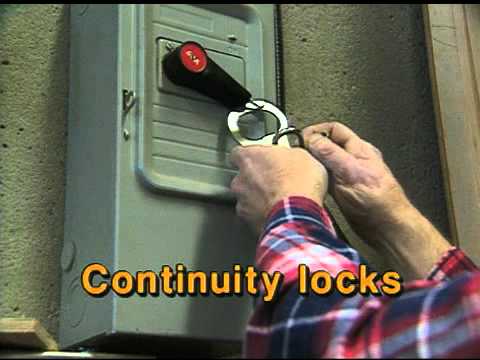
Watch Lock Out Procedures by SAFE Work Manitoba on YouTube.
For the wider application context, review Boyue’s industrial lockout applications. The article on padlock station organization addresses storage, while the miniature circuit breaker lockout overview covers a different device category. Neither should be taken as an equipment-specific isolation procedure.
Frequently asked questions
Is a group lockout box the same as a padlock station?
No. A station organizes stored equipment. A group lockout box is used in an approved arrangement to restrict access to isolation-lock keys while participating workers’ personal devices remain applied.
Does every worker put their personal key inside the box?
In a typical arrangement, the captured keys operate the equipment isolation locks. Workers retain control of their own personal-lock keys. The exact arrangement must follow the approved site procedure.
Can one supervisor’s lock cover the whole crew?
A coordinator’s lock does not replace each participating worker’s required personal protection. Define coordination and individual participation separately in the approved procedure.
Is the printed hole count enough to choose a box?
No. Check usable attachment positions with the intended locks, closure design, approved control arrangement, and actual crew size. Confirm that keys remain inaccessible as required while personal protection remains applied.