
Gate Valve Lockout Sizing: Measure the Wheel and Check Fit
Gate valve lockout sizing starts with the outside diameter of the actual handwheel, followed by wheel thickness, stem clearance, surrounding space, and padlock fit. Do not select a cover from the pipe’s nominal size or the valve body’s nameplate alone. A cover must enclose the intended handwheel and close in its approved configuration without forcing, cutting, or changing the product. Use the supplier’s current drawing and a representative sample to confirm the final fit. This guide helps maintenance buyers collect the right measurements and compare options before ordering.
Correct physical fit supports a lockout arrangement; it does not prove that a valve provides adequate process isolation. The required valve position, isolation method, pressure controls, and verification belong in the equipment-specific procedure approved for the work.
Which dimension actually determines the starting size?
For a circular handwheel cover, the first screening dimension is normally the handwheel’s outside diameter. That means the complete edge-to-edge span across its center, including any rim or projecting feature that must be enclosed. The diameter of the pipe, valve bore, stem, or wheel’s center opening is a different measurement.
Even after the diameter falls inside a listed range, the cover may fail to close because the wheel is unusually thick, a stem projects into the enclosure, or nearby pipework blocks the hinge movement. Treat the range as a starting filter rather than a complete fit guarantee.
A practical measurement record identifies the asset and shows where each dimension was taken. A photograph containing the wheel and its surroundings can explain an obstruction that a single number misses. Take measurements only under the site’s approved safe-access conditions; never reach into hazardous equipment simply to complete a purchase form.
Record these five fit checks
| Check | What to record | What the supplier needs to confirm |
|---|---|---|
| Handwheel outside diameter | Largest span across the complete wheel, with units | The listed size range and required clearance cover that wheel |
| Wheel thickness and hub profile | Overall depth, including relevant hub projections | The cover’s usable internal depth accommodates the profile |
| Stem and central clearance | Stem projection and the path through the cover opening | The approved opening clears the stem without modifying the cover |
| Surrounding access | Nearby pipework, insulation, guards, walls, and hinge-opening space | The cover can be positioned, closed, locked, and inspected |
| Padlock interface | Intended shackle diameter, usable length, and access direction | The selected lock closes through the intended locking features |
This is a buyer’s fit checklist, not a regulatory dimension standard. Handwheel-cover products differ in their internal shape and permitted use. Ask for the actual drawing or fitting instructions rather than comparing photographs by eye.
Example size ranges from the Boyue GV series
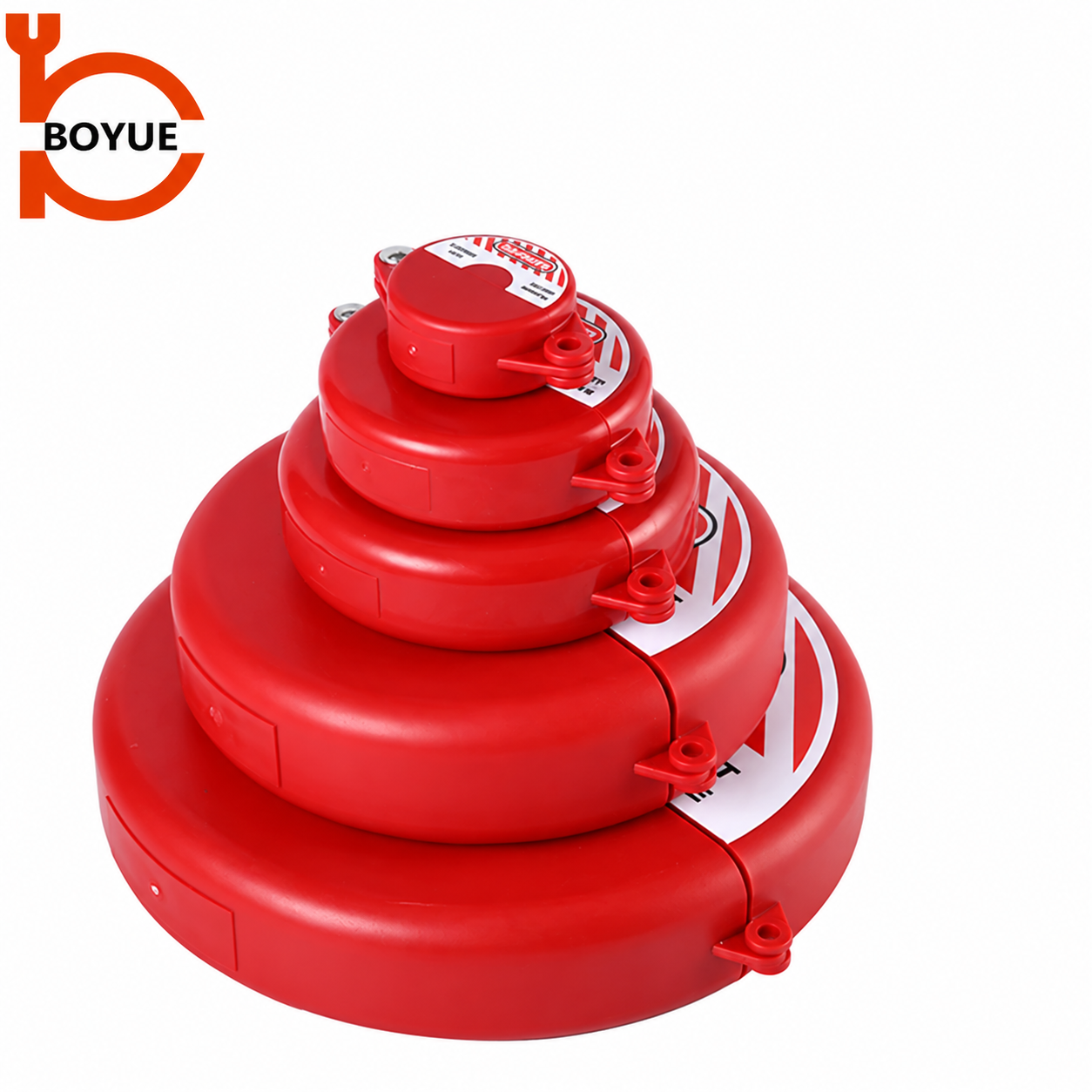
The Boyue GV-01–GV-06 gate valve lockout product page lists the following handwheel diameter ranges. These are supplier-listed product ranges, not independently measured tolerances. Confirm the current variant and drawing for the intended order.
| Listed model | Listed handwheel diameter range, inches | Additional decision before ordering |
|---|---|---|
| GV-01 | 1 to 2½ | Check wheel depth and access to the locking ears |
| GV-02 | 2½ to 5 | Check hub profile and nearby obstructions |
| GV-03 | 5 to 6½ | Confirm stem clearance and complete closure |
| GV-04 | 6½ to 10 | Confirm handling space and intended padlock fit |
| GV-05 | 10 to 13 | Check installation access around the larger cover |
| GV-06 | 13 to 18 | Confirm the actual enclosure envelope and site accessibility |
At a shared endpoint such as 2½ inches, the table alone cannot decide which adjacent model gives the approved fit. Manufacturing tolerances, the wheel profile, and the closure design still matter. Do not round the measurement downward to make a smaller model appear suitable.
A measurement workflow that produces a useful quotation
Identify the wheel and the approved valve position
Start with the asset tag and the actual valve the maintenance procedure identifies. Confirm that the photograph belongs to that asset rather than a similar valve beside it. The position that must be secured comes from the isolation plan; a buyer should not assume that every valve must be locked closed.
HSE’s guidance on the safe isolation of plant and equipment places valve arrangements inside a wider process-isolation assessment. It is useful background for understanding why a handwheel cover and a safe process boundary are separate decisions.
Measure the full profile, keeping the units explicit
Record the outside diameter and the complete depth of the part to be enclosed. Include the hub where relevant, and note whether the stem rises or occupies additional space in the required position. A measurement of the flat rim alone can miss the feature that prevents closure.
Keep the original measurement and its unit on the inquiry. If different drawings use different units, resolve the conversion before approval. Do not mix a millimetre measurement with an inch range or substitute a rounded catalogue label for the actual dimension.
Photograph the clearance around the valve
Provide an overall photograph plus a side view that reveals the available opening space. Include fixed obstructions and insulation boundaries. Explain whether the device must be fitted from one side, whether gloves limit hand access, and whether identification must remain readable after installation.
A cover that fits a loose handwheel on a desk can still be unsuitable on the installed assembly. The supplier needs the real envelope, not just a close-up that removes every nearby obstruction.
Check the intended personal padlock
Supply the actual padlock model or its relevant shackle dimensions. Confirm that the shackle passes through the approved locking features and closes completely. Inspect whether the lock body or tag interferes with a pipe, bracket, or inspection point.
For the separate question of who can open each lock, review safety padlock keying systems. Cylinder keying and physical shackle fit solve different problems; neither should be inferred from a red body or a product photograph.
Fixed-size or adjustable cover?
A fixed-size cover can make repeat ordering straightforward when a facility has verified, consistent wheel dimensions. Its usefulness depends on the actual fit, not a general claim that one size is stronger or safer than another. Record the accepted device against the asset so replacement orders remain traceable.
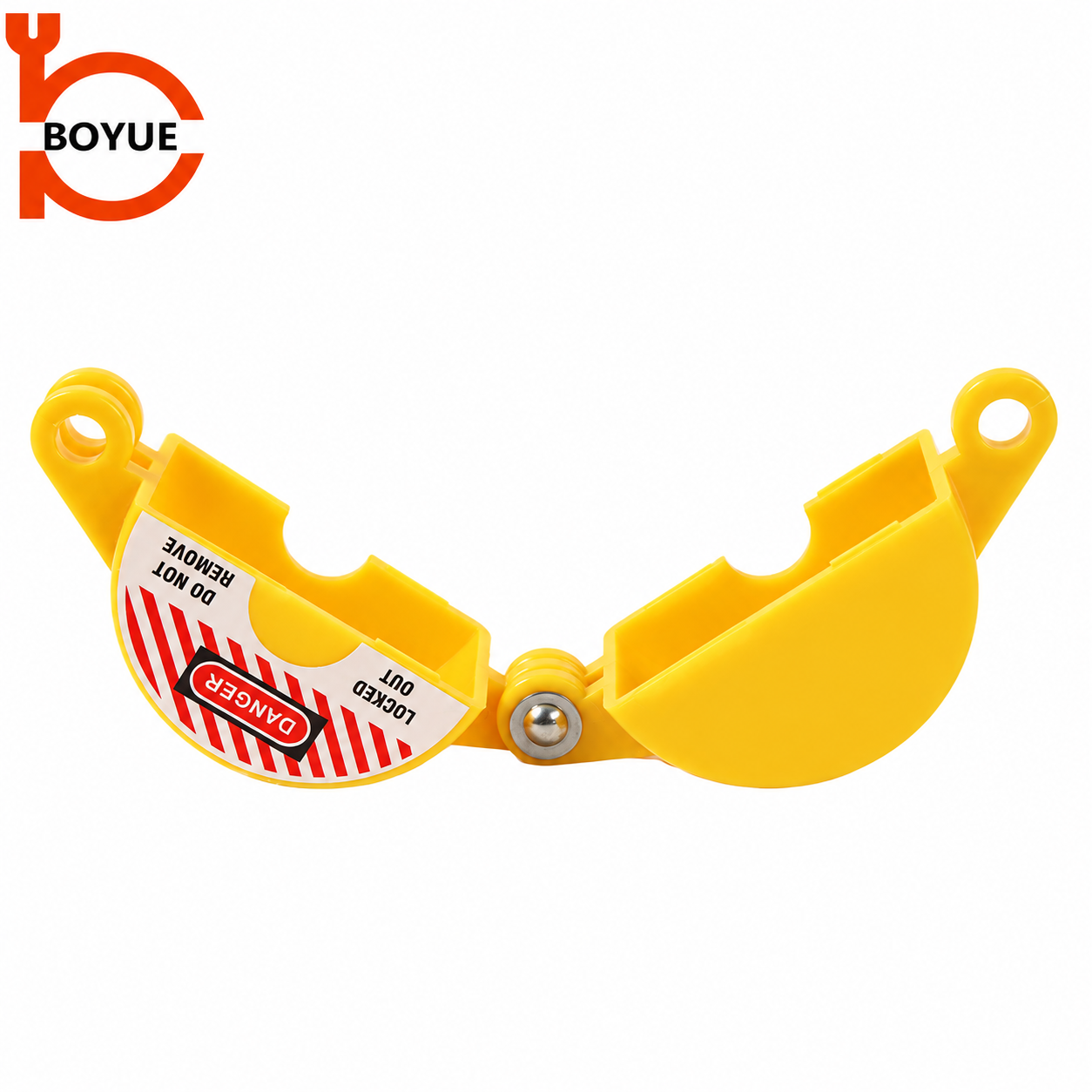
An adjustable design may cover several wheel sizes, but the buyer must still verify its adjustment mechanism, internal clearance, approved locking positions, and instructions. An advertised diameter span does not establish that every wheel profile within that span is compatible.
For either approach, consider the number of genuinely different wheel profiles in the plant. Buying fewer catalogue lines may simplify storage, yet an overbroad substitution can create fit failures. A controlled sample evaluation is more informative than choosing whichever description contains the word universal.
Worked example: a wheel between catalogue endpoints
Suppose a fictional asset has a handwheel with a measured outside diameter of 3½ inches. The listed Boyue table makes GV-02 a candidate because that diameter sits between its stated endpoints. It does not complete the selection: the buyer still supplies the wheel depth, hub shape, stem projection, surrounding access, and intended padlock details.
Now suppose the sample cover reaches the wheel but its shells do not meet without pressure. That result is a fit failure to investigate, not an invitation to force the hinge or shave material from the edge. Ask whether the wheel profile, stem opening, selected variant, or measurement needs correction.
The final record should identify the exact model accepted for that asset and the conditions checked. The example is a procurement illustration only; it does not describe a Boyue field trial or establish any pressure-isolation performance.
Bench acceptance before site issue
Check the delivery against the approved sample and drawing. Inspect shell shape, hinge movement, locking ears, openings, labels, and visible damage. Confirm that the delivered model and size correspond to the order rather than relying on colour alone.
Where a safe representative fitting arrangement is available, check enclosure and lock engagement without a live process depending on the result. Do not drill a new hole, trim a stem opening, alter the hinge, or substitute a smaller lock to make an unsuitable cover appear acceptable. Changes to a safety device need the appropriate manufacturer and site review.
The CCOHS lockout guidance explains the wider need to address hazardous and residual energy. A correctly sized cover remains only one part of that control system. Personnel must follow the applicable site procedure before carrying out work.
What to include in a gate valve lockout inquiry
Send the asset identifier, handwheel outside diameter and depth, stem-clearance information, photographs, intended valve position, padlock details, required quantity, and label language. Add the relevant environmental exposure so the supplier can confirm material suitability for the exact variant.
Ask the supplier to distinguish verified product data from assumptions that still require a sample. Request clear identification of any unresolved fit condition. For general application discussions, see Boyue’s industrial lockout applications. If several workers participate in an approved lockbox arrangement, the separate group lockout box procedure guide explains the key-control questions to resolve.
Training context
The educational video Lock Out Procedures from SAFE Work Manitoba introduces the wider energy-control context. It does not show a certified fit test of a Boyue valve cover and does not replace local requirements or the equipment-specific procedure.
Watch Lock Out Procedures by SAFE Work Manitoba on YouTube.
Frequently asked questions
Can I choose the cover from the pipe diameter?
No. Start with the actual handwheel outside diameter, then check wheel depth, stem clearance, surrounding access, and the intended padlock. Nominal pipe size does not supply those dimensions.
What if the wheel is exactly at the endpoint between two models?
Confirm the current drawing, tolerances, and sample fit with the supplier. Do not assume the smaller adjacent model will close correctly or round the measurement to fit a preferred catalogue size.
Can I cut the cover to clear a projecting stem?
Do not modify the cover to force compatibility. Ask for a suitable approved configuration or a different design and obtain the manufacturer’s and site’s review where necessary.
Does a fitted cover prove the valve is a safe isolation boundary?
No. Physical fit does not verify valve integrity, absence of pressure, or suitability of the isolation arrangement. Those conditions require the approved equipment-specific process and verification.