
Safety Padlock Identification: Employee Labels and Issue Records
Safety padlock identification should let a person at the isolation point determine whose personal protection the lock represents, using the employer’s approved marking and record system. A red body, a familiar brand or a serial number without a usable assignment record is insufficient information on its own. Before issuing a lock, connect its readable identity to the authorized employee, distinguish it from equipment and storage locks, and check that the marking will remain usable in the expected environment. This guide explains how to organize those decisions without changing an active lockout or confusing identity with permission to remove a lock.
Separate employee identity, lock identity and equipment identity
Three different questions often become compressed into one label. Employee identity answers who applied the personal device. Lock identity distinguishes this particular item from other locks. Equipment identity tells workers which machine, valve or isolation boundary the job concerns. Each has a purpose, but none automatically answers the other two questions.
For example, a hypothetical lock marked P-218 might be a useful stock identifier. If nobody at the work location can connect P-218 to its current authorized user, the stock number has not solved employee identification. Similarly, writing Pump 2 on a lock does not identify the employee whose protection it represents. Design the record so these relationships can be checked without guessing.
The identification requirement in OSHA 1910.147(c)(5)(ii)(D) concerns the employee applying the device. The exact local marking method should be established by the employer. Do not turn a convenient label format, color code or computer field into a claim that every workplace must use that same format.
Decide what belongs on the visible marking
A practical label review starts with the people who must read it. Ask whether employees, supervisors and approved contractors can identify the current user through the site’s chosen method. A full name may be helpful, while duplicate names may need a department or controlled identifier. Include only information that serves the workplace process and fits the employer’s privacy rules.
Contact details can help coordination, but they are not a substitute for the employee’s identity. A workshop telephone answered by several people may be useful as a secondary route. It should not leave the reader assuming that any person answering the call owns every lock with that telephone number. Define how the contact route and individual assignment relate.
Also distinguish permanent fields from fields that change with each job. A personal lock’s asset number may remain stable. The machine number, work order or application time may belong on the associated job tag or record. Repeatedly layering new labels over old information makes ambiguity harder to spot and can hide damage or manufacturer markings.
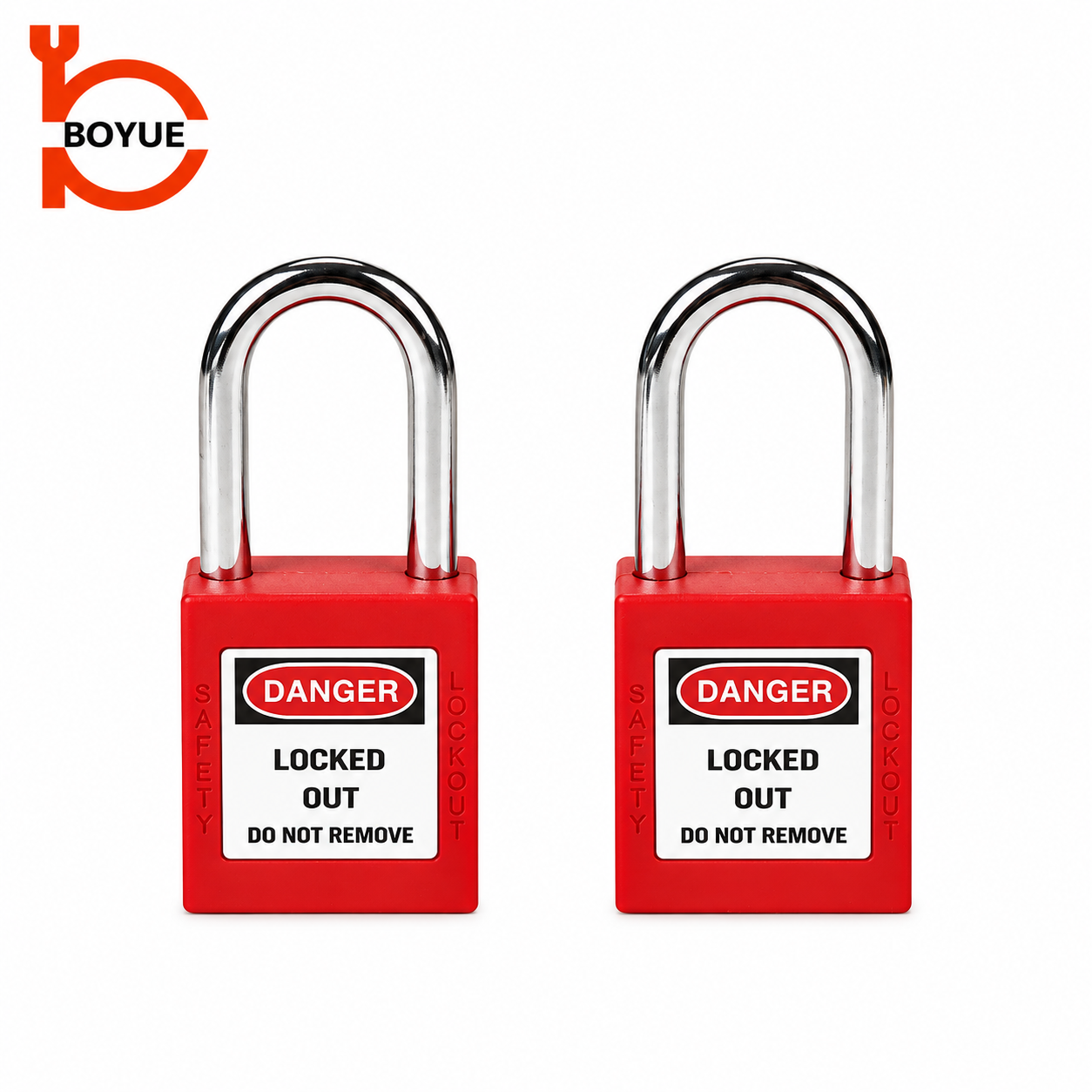
The steel-shackle products shown here illustrate physical locks, not a finished identification program. For the actual BOYUE 38mm steel-shackle safety padlock, confirm the supplied marking options and usable label area rather than estimating them from a photograph. Do not cover the keyway, moving parts or operating instructions.
Use an issue record that matches the physical lock
An issue register is useful only when its entries match the items people carry. Before first issue, compare the visible lock identifier, the assigned employee and the relevant key-control reference. Have the receiver confirm the assignment through the employer’s established process. A shipment list proves what arrived; it does not prove which employee now controls an individual item.
Suggested fields include the lock identifier, employee identifier, issue date, responsible issuer, current status and a reference to the applicable key-control arrangement. These are organizational suggestions, not a prescribed legal form. Avoid recording sensitive key information in an uncontrolled worksheet. Access to identification records and access to opening devices serve different purposes.
For spare or returned locks, make the unassigned state obvious in storage. A returned item carrying the previous user’s label can appear ready for that person’s next job even when its key arrangement or assignment has changed. Resolve the identity, condition and authorized reissue process before it joins the available stock. Do not use a label change to bypass the controls for a lost key or an unexplained return.
A marking and record review checklist
Use this qualitative checklist when designing or reviewing your own issue process. It supplements the employer’s program; it does not establish product durability ratings or a universal inspection interval. OSHA’s materials and hardware tutorial explains the underlying durable, standardized and identifiable hardware principles.
| Review point | Evidence to compare | Decision when unclear |
|---|---|---|
| Current employee | Visible marking and current assignment | Hold unused stock until the employee can be identified |
| Unique physical item | Lock identifier and issue entry | Investigate duplicate or missing identifiers |
| Purpose | Site distinction between personal, isolation and storage locks | Keep categories separate until their roles are confirmed |
| Readability | Marking under the expected viewing and exposure conditions | Use an approved replacement marking method |
| Reissue status | Return record, condition decision and new assignment | Keep the item outside ready-to-issue stock |
| Active lock with damaged label | Existing job records and responsible authorized personnel | Maintain protection and use the employer’s controlled resolution process |
Check the complete chain rather than approving columns individually. A perfectly readable label connected to an outdated register still creates uncertainty. Conversely, a current register does not make a label hidden behind another device easy to read. Trial the arrangement using an unused sample before rolling it out to a full crew.
Check exposure and legibility using a representative sample
Label suitability depends on what the marking will encounter, including moisture, cleaning agents, abrasion, sunlight and handling. Ask the supplier for the documented limits of the exact label and application method. The fact that the lock body remains intact does not establish that handwriting, adhesive or printing will remain readable throughout the intended exposure.
A sample review can reveal practical problems without inventing a laboratory rating. Apply the approved marking to an unused sample using the specified surface preparation. Confirm that normal handling, gloves and the planned storage method do not obscure essential information. Use only an employer-approved assessment for expected exposure; do not subject working safety equipment to improvised destructive tests.
Include readability at the real viewing position. Small text that looks clear on a desk may be hidden when the lock hangs among several other devices. If reading requires manipulating an active arrangement, redesign the unused sample and obtain approval before future issue. Never rearrange somebody else’s active protection merely to obtain a better photograph or read a covered number.
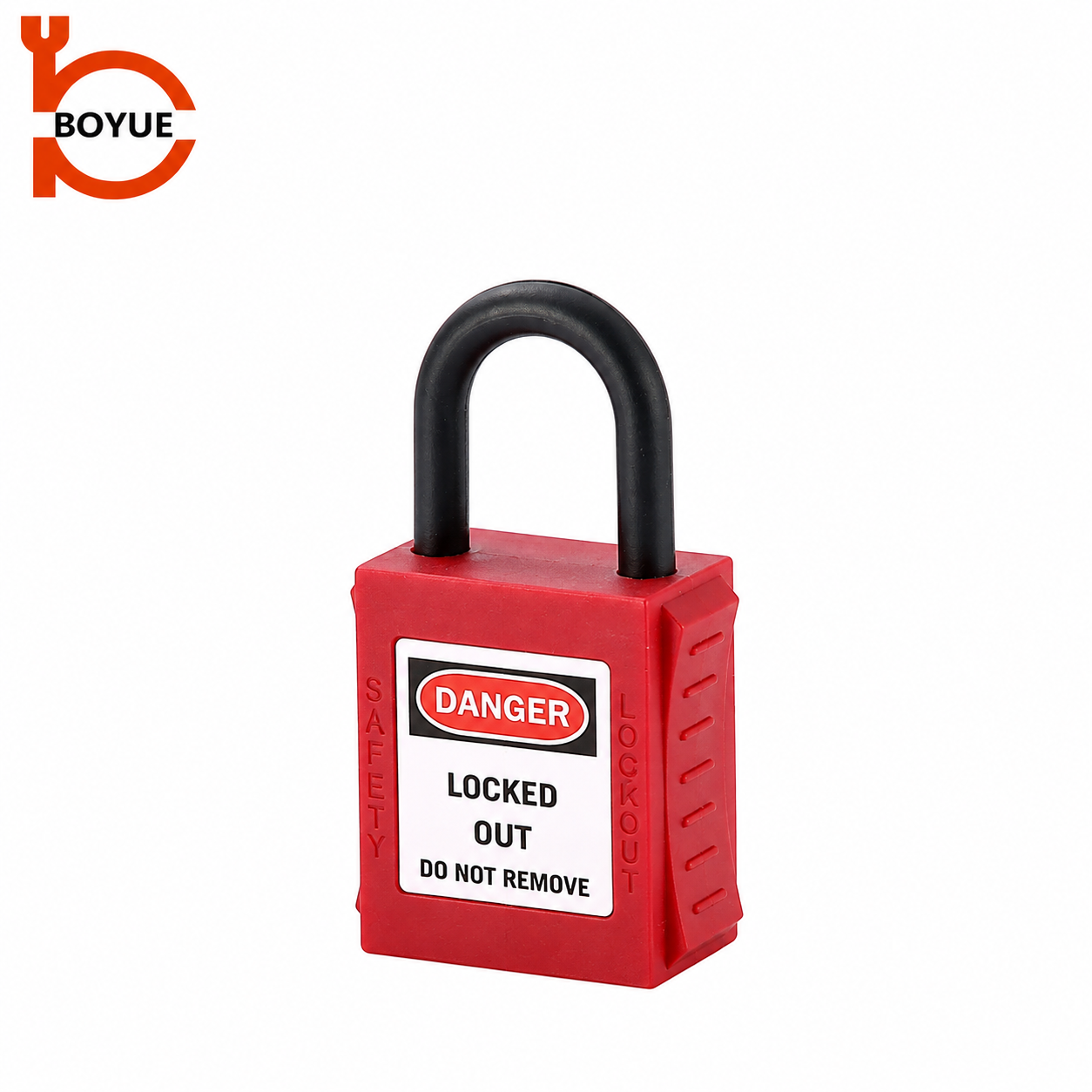
The PL25 insulating-shackle illustration shows another product form that may appear in a lock inventory. Its appearance does not establish an electrical protection rating or authorize a particular task. Keep product identity and documented application limits separate from the employee’s identification fields, even when both are recorded on the same inventory page.
Handle duplicate identities and changed assignments
Duplicate employee names are a predictable record problem. A site-approved employee identifier or another clear distinction can prevent two people being treated as one. Agree how temporary staff and contractors are represented before their locks enter service. A contractor company name alone may identify an organization while still leaving the individual user uncertain.
When employment, department or assignment changes, update the unused stock through the controlled process. Preserve enough history to explain earlier records, while making the current assignment unambiguous. Do not erase an old name in the register and assume the physical label has changed. Compare both before the next issue, and record the person responsible for the change.
If an active lock has an unreadable or conflicting identity, keep the protective arrangement intact and involve the responsible authorized personnel. An identification discrepancy does not grant removal authority. Resolving who applied the lock, where that person is and what work remains requires the employer’s established controls, including its special removal procedure when applicable.
Keep identification separate from key compatibility
Two locks with the same body color or brand can have different cylinder arrangements. Two different asset numbers also do not prove that their keys cannot open each other’s locks. The safety padlock keying systems guide addresses that separate purchasing and control decision. Identification should reference the approved arrangement without making assumptions from appearance.
For receiving staff, this means checking the order and supplier records rather than casually trying a collection of keys on issued locks. For supervisors, it means keeping employee assignment changes aligned with the approved key process. A replacement sticker cannot correct an unauthorized shared key arrangement or establish that a missing key has been controlled.
Physical condition also remains a separate acceptance step. Use the safety padlock inspection checklist for hardware checks. A legible name does not repair a damaged shackle, unreliable mechanism or uncertain product identity. Treat identification, hardware condition and key control as connected records with distinct decisions.
Review a group-job example before adopting the system
Imagine a planned shutdown involving employees from two departments and one contractor. Before issue, the coordinator compares the personal lock identifiers with the approved roster and confirms how contractor identities will be understood. Isolation-lock identifiers are recorded separately from personal-lock assignments so a list of machine locks is not mistaken for a list of protected people.
During a document trial, ask a person unfamiliar with the crew to explain whose protection each sample represents. If they can identify only the department or the equipment, improve the method before use. The group lockout box shift-change guide covers continuity of protection; labeling should support that process without replacing its handover checks.
Record the unresolved questions and the person who will close them. Useful evidence includes the approved label sample, an example issue entry, the reissue method and the location of the controlled register. These small preparation steps make the next receiving or issue decision easier to verify and reduce dependence on one person’s memory.
Educational overview of the wider lockout process
SAFE Work Manitoba’s educational video places hardware and communication within a broader lockout process. Use it as background training material; apply the employer’s own equipment-specific procedure and applicable requirements to actual work. The identification checks above remain useful even when a video is unavailable.
Watch Lock Out Procedures by SAFE Work Manitoba.
Frequently asked questions
Does a red padlock identify the employee?
No. Color can support the site’s standardization system, but the current employee must be identifiable through the approved marking and assignment method. A red body alone does not establish who applied the lock.
Can an asset number replace a name on every site?
Do not assume so. The employer must ensure its chosen method identifies the employee applying the device. Assess the visible marking together with accessible, current records and the applicable site requirements.
Should an unreadable label be fixed by removing an active lock?
No. Maintain protection and involve the responsible authorized personnel. Resolve the identity through the employer’s controlled process; a label problem does not authorize removal or interruption of protection.
Does relabeling a returned lock make it ready for reissue?
No. Confirm its return status, current assignment, hardware condition and approved key-control arrangement. Reissue should be recorded only after those separate questions have been resolved.