
Group Lockout Box Shift Change: Handover and Continuity Checks
A group lockout box shift change must preserve protection while responsibility and personnel change. The incoming team needs the current work scope, isolation record, equipment condition, unresolved hazards and the employer’s documented transfer sequence before entering the exposure area. Personal protection and group coordination must remain effective throughout the transition. Do not open the box, release isolation keys or remove another person’s lock merely because a shift has ended. This guide helps teams prepare and check a handover; it does not supply a universal lock-transfer sequence for every plant or replace an approved group lockout procedure.
Define the handover outcome before the shift ends
A successful handover leaves no uncertainty about who coordinates the work, which equipment remains isolated and who is protected. Finishing a conversation or signing a sheet is not enough if the physical protection and actual exposure status do not match that record.
Start preparation early enough to resolve discrepancies while the outgoing personnel are available. Identify the incoming responsible person, participating crews and the work that will continue. Check whether contractors, late arrivals or a change in task scope require additional coordination. Avoid planning the transfer around an assumed arrival time that no one has confirmed.
For the initial setup and the distinction between isolation locks and personal locks, use the separate group lockout box procedure. Here the focus is the change between work periods, including incomplete work and unresolved conditions, rather than repeating the initial setup process.
Establish the applicable procedure and responsibilities
For covered US general-industry work, OSHA 1910.147 requires specific arrangements for continuity during shift or personnel changes. Its group requirements also address coordination and individual protection. Applicability matters: electrical exposure and other industries can involve different or additional requirements. Confirm the employer’s relevant procedure before transferring control.
Distinguish the person coordinating the group isolation from each authorized employee performing exposed work. A supervisor’s name on the handover form does not establish that every individual is protected. The procedure must account for actual participation, departures and the status of each crew.
Local programs can use different organizational roles. The Berkeley Lab lockout program illustrates a documented institutional approach; its role names and detailed methods belong to that program. Do not transplant them to another workplace without evaluating the local procedure and responsibilities.
Reconcile the work scope and isolation record
Identify the equipment by its site designation, not only by a convenient description such as “the pump.” Review the work boundaries, current job or permit reference and the isolation list. The incoming person should be able to distinguish the protected equipment from adjacent systems that remain operational.
Describe what changed during the outgoing shift. Examples include removed components, installed temporary supports, disconnected lines, unfinished guards or a task that stopped before a planned verification step. These are prompts for accurate reporting, not assumptions that such changes occurred on the job.
Check that the record version matches the current work. A clean copy printed at the beginning of the outage can become misleading if later authorized changes were recorded elsewhere. Resolve inconsistent identifiers or missing updates before personnel rely on the transfer. A second signature on an inaccurate list does not make the list accurate.
Understand what the box protects
The BOYUE GL-01 / GL-02 group lock box family is a product reference for the key-containment component. Confirm the exact supplied model, locking positions and closure arrangement. An available hole count or photograph does not establish the maximum crew size for a particular procedure.

The open-box illustration shows the component for identification and inspection. It does not depict an approved state during an active protected handover. Do not open a secured box to count keys while people rely on it. Any required reconciliation must use the approved records and safe procedure, with protection maintained.
Confirm the box identifier and location against the job record. A nearby box with similar red paint may protect different equipment. If the box has been moved, the incoming team needs its current location and reliable identification; movement alone should not cause them to rely on an unverified substitute.
Review individual protection and exposure status
Establish who is still working, who has stopped exposed work and who will enter during the next period. A crew roster is useful only if it reflects the people actually involved. Resolve a name on the sheet without a corresponding understood protection arrangement, or a lock whose owner cannot be identified.
The exact sequence for outgoing and incoming devices comes from the employer’s procedure. Do not generalize that everyone should remove locks at a fixed time, or that passing a key between employees transfers personal protection. Personal locks, coordination locks and isolation locks can have different roles; the procedure must make those roles explicit.
A late replacement or absent outgoing worker requires the documented contingency, not an improvised exception. If the planned transfer cannot preserve protection, stop exposed work and escalate to the designated responsible person. A shift deadline does not authorize cutting a lock or leaving a protection gap.
For ownership and key arrangements, consult the complementary safety padlock keying guide. Similar padlock colors do not establish interchangeable keys or permission to remove a device.
Make the briefing specific to current conditions
Discuss stored-energy controls and any condition that requires continued attention. The incoming team needs to know the actual controls in place, the verification status and any possibility of energy returning. Do not reduce this to the statement “everything is off.”
Explain paused work, incomplete checks and access restrictions. For example, a job may be isolated while a separate test or mechanical support decision remains unresolved. Describe the limitation explicitly and identify who can resolve it. The incoming crew should not infer that a box with locks means every planned activity is already authorized.
Ask the incoming responsible person to confirm the equipment identity, remaining task and unresolved points in their own words. This is a communication check, not a replacement for required physical verification. Any disagreement between briefing, record and equipment condition should stop the transfer until it is resolved.
Use a handover decision table
This original table is a preparation aid, not a lock-removal sequence or a legal checklist. It focuses attention on information and conditions that need a documented decision under the site’s approved process.
| Handover item | Evidence to reconcile | If it cannot be reconciled |
|---|---|---|
| Equipment and box identity | Job record, equipment identifier and box designation agree | Stop transfer; resolve the mismatch |
| Work scope and current condition | Updated record identifies remaining tasks and temporary arrangements | Restrict work until the scope is clarified |
| Responsible personnel | Outgoing and incoming coordination roles are understood | Escalate; do not assume responsibility transferred |
| Individual participation | Actual exposure status matches the protection arrangement | Stop affected work and resolve participation |
| Isolation and verification status | Procedure records and reported conditions are consistent | Obtain the required competent verification or investigation |
| Late arrival, absence or damaged hardware | Approved contingency preserves protection | Use the contingency; otherwise keep exposed work stopped |
Distinguish continuity from a new isolation decision
OSHA’s 2023 group lockout interpretation discusses verification in a defined group scenario and employees’ opportunity to verify effectiveness. It should not be read as a blanket instruction to skip verification at handover. The actual conditions, applicable rules and employer’s procedure determine what is required.
If the work boundary changes, a new energy source is identified or there is concern that protection was disturbed, treat that as an unresolved control issue. Do not use a completed handover form to continue automatically. The designated personnel must assess the change and establish the necessary controls and verification before exposed work resumes.
Likewise, a planned test or temporary energization is a separate procedural event. It must not be smuggled into the shift transfer by briefly opening the box or releasing keys. Keep the test authorization and restoration of protection explicit and controlled under the relevant procedure.
Check hardware concerns without defeating protection
Before a job begins, inspect the box, closure and specified lock interfaces. During handover, report any new damage or interference that can be observed safely. Do not dismantle a protected assembly to improve a photograph or check an inaccessible feature while personnel depend on it.
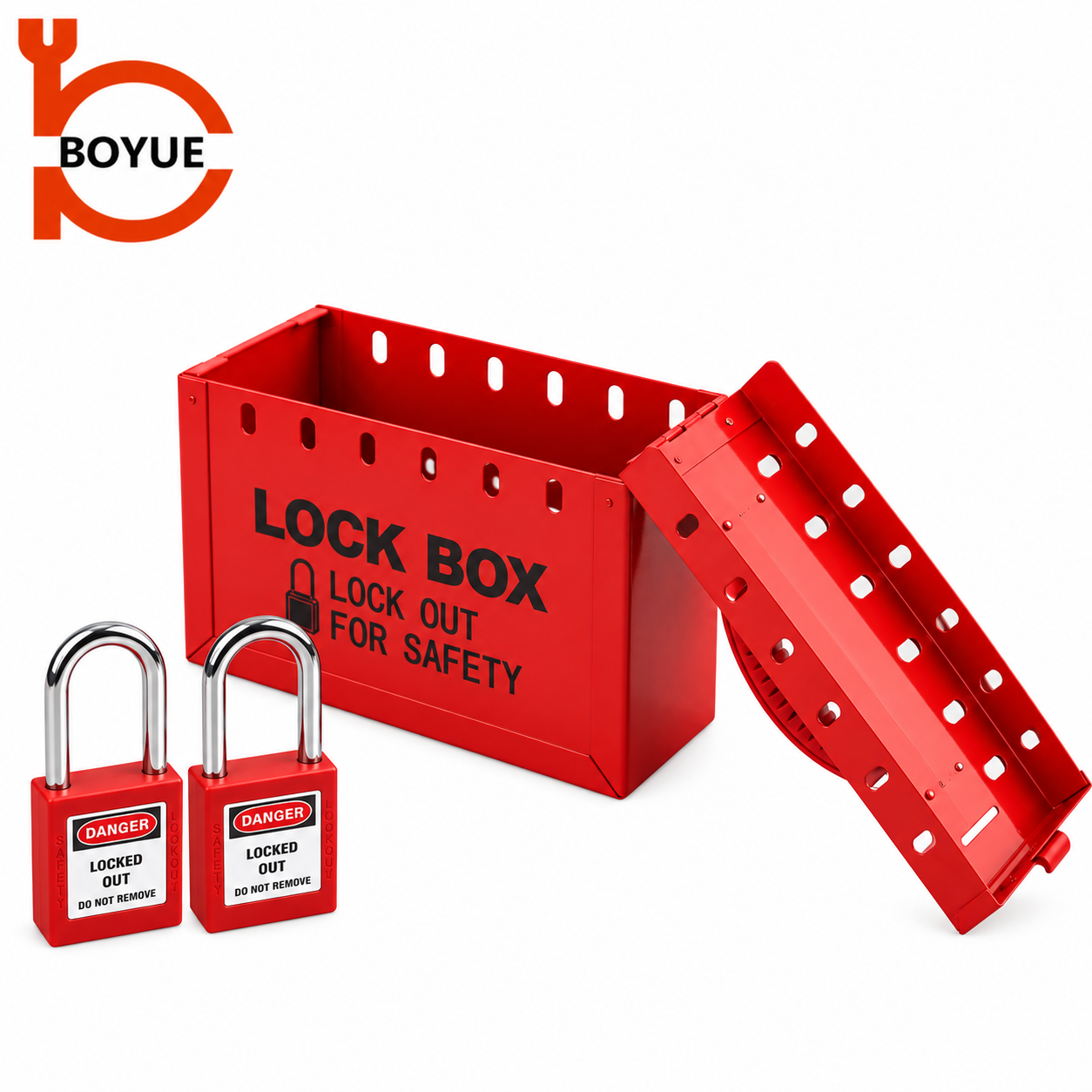
The separate personal padlocks in the illustration show components, not a validated live transfer arrangement. Any additional hasp, extension or substitute lock needs confirmed compatibility. Extra hardware added merely to create space can change how the closure is restrained.
If replacement is necessary during active work, the responsible person must implement a procedure that preserves protection. Identify the defect, affected job and current exposure status before deciding the replacement method. Keep the withdrawn component out of ready stock after the protected replacement has been completed.
Close the handover record and keep release separate
Record the time, outgoing and incoming responsibilities, record version, work status, unresolved restrictions and any required follow-up. Preserve a clear distinction between “responsibility transferred” and “equipment ready to restart.” A signed transfer can leave the machine intentionally isolated for unfinished work.
Communicate the accepted status to affected crews through the established process. If another crew joins later, it needs the relevant briefing and protection arrangements before starting exposed work; the earlier transfer does not automatically cover new participants.
Return-to-service decisions belong to the release procedure after the relevant work and checks are complete. Keep handover records available so the final responsible personnel can understand what occurred across shifts. A useful record supports a safe decision; it never authorizes bypassing the physical protection.
For a proposed additional multi-lock component, the lockout hasp selection guide addresses interface questions. Selecting a hasp does not authorize changing an active group-box arrangement during a transfer.
Further learning: communication within lockout
The SAFE Work Manitoba video introduces the wider lockout process. Use it as background for communication, isolation and verification. It does not demonstrate a complete multi-shift group-box transfer or replace the employer’s written contingency arrangements.
Watch Lock Out Procedures by SAFE Work Manitoba.
Frequently asked questions
Can the box be opened to check the keys during handover?
Not while workers rely on its secured state. Use the employer’s approved reconciliation and transfer method, maintaining protection. Opening a protected box is not a routine substitute for accurate records.
Does the outgoing shift always remove every lock?
No universal sequence applies to every system. Different locks can have different roles. Follow the documented transfer sequence and preserve both individual protection and group coordination throughout the change.
What if the incoming employee arrives late?
Use the approved contingency. If continuity cannot be maintained under that arrangement, stop exposed work and escalate. An expected arrival time does not establish that replacement protection is present.
Does signing the handover authorize a restart?
No. Handover transfers responsibility and communicates current conditions. Restart requires the separate return-to-service process, including the required work-area, personnel and removal checks under the applicable procedure.