
Cable Lockout Device: Routing, Fit and Selection Checks
A cable lockout device is suitable only when its approved routing, locking mechanism and cable size can hold the intended energy-isolating device in its required safe position. Choose it by checking the complete cable path, remaining movement, padlock fit and working environment. Buying a longer cable does not automatically solve a poor anchoring arrangement. Before ordering, record the isolation point, measure its openings, and prove the proposed fit using an exact sample under an approved procedure.
This guide helps maintenance buyers compare cable designs and prepare a practical acceptance check. It addresses hardware selection, rather than replacing the machine-specific isolation procedure. For the available product family, start with BOYUE cable lockouts.
Start with the isolation point and the permitted cable path
Identify the component that actually isolates energy. A cable placed around an operating control may look convincing while leaving the true energy source available. The site’s authorized person should identify the isolation point and required safe position before anyone selects hardware. Record the equipment reference and photograph the proposed route with the equipment already made safe for inspection.
Describe what the cable must prevent: rotation of a particular handwheel, movement of a disconnect handle, or removal of an approved blocking arrangement. Then identify the fixed feature against which that movement will be restrained. A moving handle and a nearby moving component do not necessarily provide a usable pair of anchor points. Avoid arrangements that depend on friction against a smooth surface unless the manufacturer expressly approves them.
General safety context comes from CCOHS lockout guidance, which distinguishes energy isolation from ordinary operating controls and calls for equipment-specific instructions. The cable-selection checks below are practical purchasing checks; they do not establish that a particular installation meets a regulation.
Compare the mechanism before comparing cable length
BOYUE offers visibly different cable mechanisms. The AC-02 adjustable cable lockout uses a squeeze-handle form. The AC-03 steel cable lockout has a round body. The AC-04 fish-type cable lockout has a different closure and visible locking-hole arrangement. These differences matter because each body occupies space and requires its own approved loading and locking sequence.
| Selection question | What to inspect | Reason to reject or clarify |
|---|---|---|
| Can the cable follow the approved path? | Opening clearance, bend locations, fixed anchor and access for the free end | Cable must be forced, sharply kinked or routed over a vulnerable edge |
| Can the mechanism close correctly? | Body clearance and the manufacturer’s tightening and closure sequence | Nearby pipework prevents complete closure or hides engagement |
| Does locking prevent release? | Actual personal padlock fitted through the intended position | The lock closes but the mechanism can still release the cable |
| Is movement adequately restrained? | Residual travel of the identified isolating component | Slack or sliding permits movement outside the required safe position |
| Is the variant documented? | Exact model, cable construction, length, diameter and instructions | Quotation combines conflicting sizes or generic family descriptions |
This is a qualitative comparison checklist. It deliberately gives no universal acceptable slack, bend radius or pulling force: those limits require the selected product’s instructions and an approved application assessment.
Measure usable length and access, not just circumference
Follow the intended route with an appropriate measuring method while the equipment is safely isolated. Include the path through openings, around the approved fixed feature, and back into the device. Allow for the part of the cable that enters the mechanism and the access needed to operate it, using the manufacturer’s instructions. Do not substitute an arbitrary extra length for checking the complete route.
Record the smallest opening along that route. The free end, ferrule or other termination may be larger than the cable itself. A nominal cable diameter therefore cannot establish whether the assembly will pass through a locking eye. Check the supplied end detail and the usable opening, including paint build-up, edge shape and obstructions behind the opening.
Extra cable can make the arrangement harder to manage. A loose tail can snag nearby equipment or obscure identification. Specify how the spare length will be positioned without bypassing the lockout or introducing a trip or entanglement hazard. Never cut or refinish an end in the field merely to make it fit unless the manufacturer specifically permits that modification.
Check retention and residual movement with an exact sample
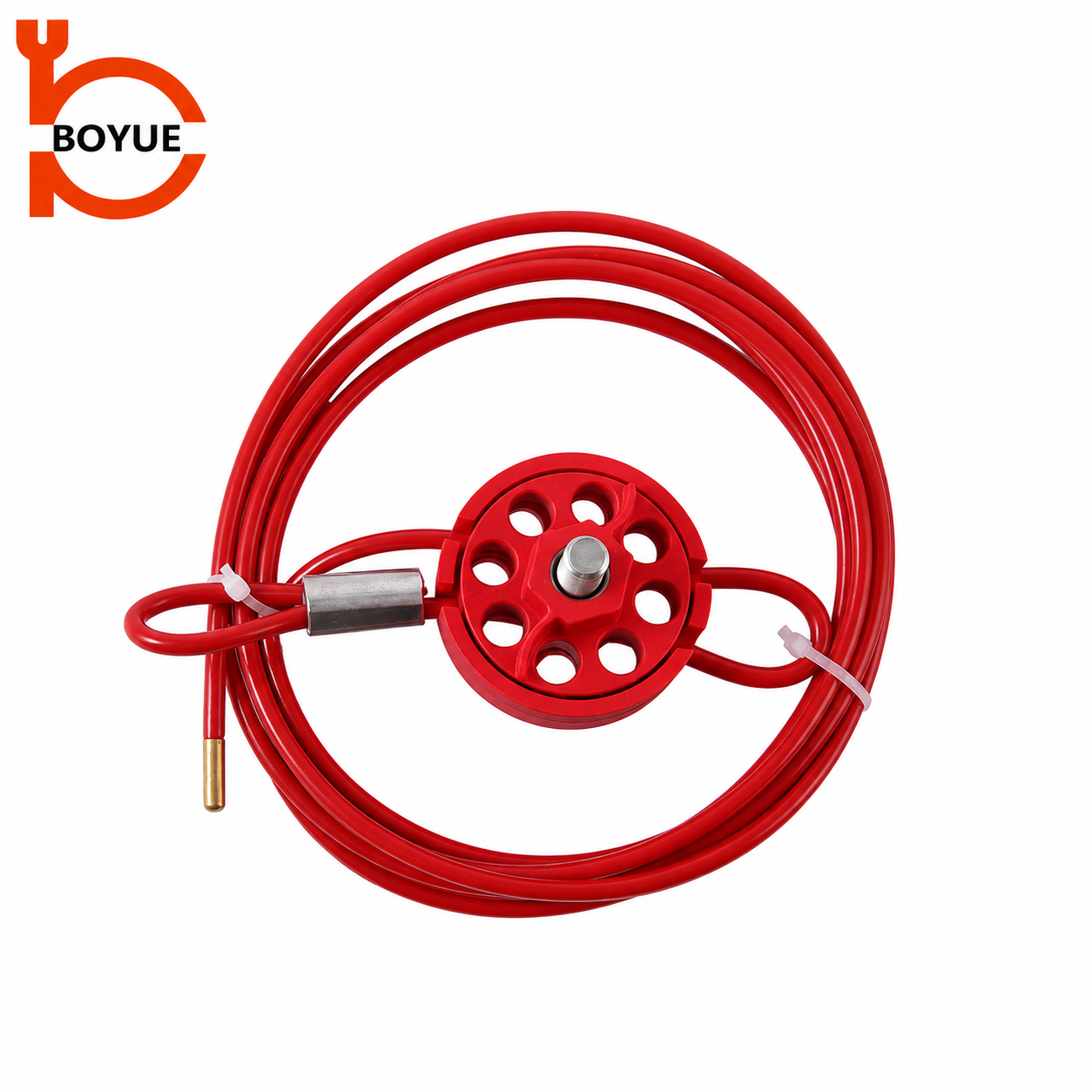
A bench demonstration establishes familiarity with the device, but the actual isolation point presents different geometry. Use a sample of the exact proposed variant on equipment that has already been made safe under the site’s rules. Follow the manufacturer’s fitting instructions. An authorized person should assess whether the intended component remains in its required position after the lock is applied.
Check the whole restraint path. The body may remain locked while the cable slides around the selected anchor. A handwheel can sometimes move within a large loop even when the cable cannot be pulled back through its mechanism. Look for changes in routing when the cable is gently repositioned within the permitted inspection method. Do not improvise destructive tests or apply a generic force without an approved test specification.
Keep hardware retention separate from verification of energy isolation. A cable that restrains a valve wheel does not demonstrate that the valve seals internally, that downstream pressure is relieved, or that other energy sources are controlled. For wheel-specific geometry, compare the separate guide to gate valve lockout sizing.
Specify cable construction and environmental evidence
Confirm the core material, coating and body material for the exact supplied model. A red outer coating is a visible finish, not proof of electrical insulation. A coated metal cable still contains a conductive core. Do not use appearance or a general catalogue adjective to claim suitability for energized electrical work.
Tell the supplier about the actual exposure: indoor storage, outdoor weather, cleaning chemicals, process splash, abrasion, temperature and expected duration. Request product-specific limits and maintenance instructions where these conditions matter. A general statement such as chemical resistant is incomplete unless the relevant chemical and exposure conditions are identified.
The current product family descriptions contain different construction and size statements across variants, so a purchase specification should identify one model and one approved configuration. Resolve any conflicting catalogue details in writing before the order. The supplier’s confirmed drawing and sample should agree; neither a generated article illustration nor a family photograph is a measurement reference.
Plan personal locks and group arrangements separately
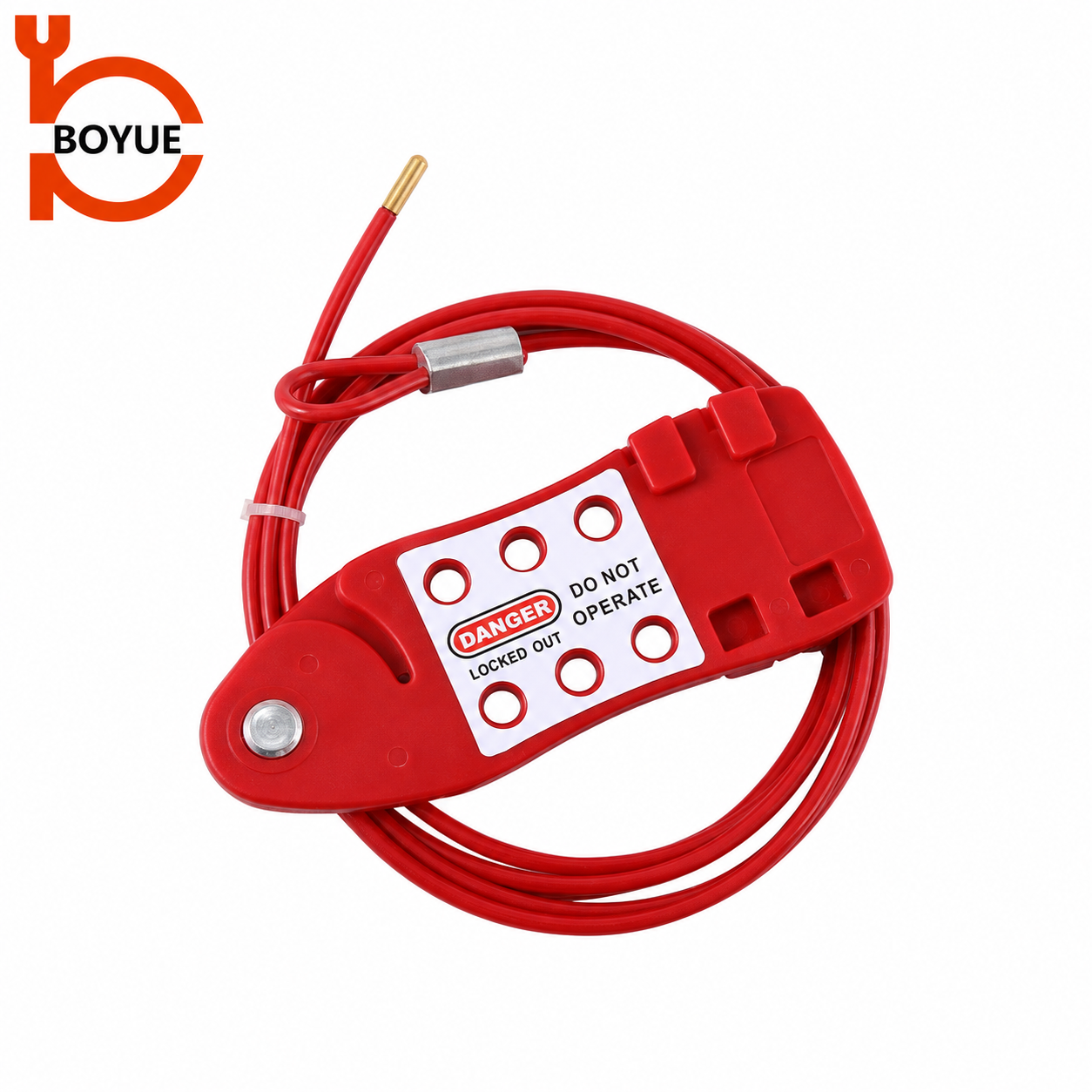
Count the people who may need independent protection, but do not turn that count directly into a cable routing plan. Establish the approved group arrangement first. Some bodies provide multiple locking positions; another design may require a compatible hasp. A hole count alone does not show whether all intended padlock bodies will fit simultaneously or whether the cable release remains blocked at every position.
Test with the actual personal locks, including their shackle diameter, usable length and body size. Check that a gloved user can access the intended position without moving another worker’s lock. An improvised chain of unrelated accessories can make identification and release control difficult. Have the arrangement reviewed before ordering a batch.
For responsibilities, key custody and crew changes, use the separate group lockout box procedure guide. For procurement of personal locks, consult safety padlock keying systems. Those decisions support cable selection but do not replace a fit check at the isolation point.
Inspect the cable and body before returning them to service
Include the complete cable length in the inspection. Look for broken strands, exposed core, cuts, severe flattening, kinks and damaged terminations. Check the body for cracks, distorted locking openings, loose parts and unreliable closure. Retire suspect equipment from use pending the site’s assessment and manufacturer guidance; do not hide damage under tape or reshape a distorted locking feature.
Keep inspection records useful by connecting a defect to a specific device or controlled batch. Note where damage developed, since repeated abrasion at the same point may show that the application needs a different route or device. Cleaning and storage should follow the supplied instructions. Do not assume that a lubricant suitable for a padlock is also approved for a cable-clamping mechanism.
Prepare an enquiry that can be checked on delivery
Send the supplier the exact isolation-point photographs, proposed routing, opening sizes, required safe position, available body clearance and personal-lock details. Include environmental conditions and the intended group arrangement. Ask for the model identifier, current instructions, confirmed cable dimensions, construction and any variant-specific limitations. Request a sample before a large order when the fit has not already been approved.
At receiving, compare the delivered model against the approved sample and quotation. Check cable end details, locking-hole arrangement, labels and instructions as well as the visible colour. If the supplier substitutes a variant, repeat the relevant assessment rather than treating the same family name as equivalence. Record the accepted arrangement so a later reorder does not silently change the installation.
Further learning: hardware within an energy-control programme
NIOSH’s hazardous energy control resource explains why a written programme must address more than electrical power. The following SAFE Work Manitoba video introduces the wider lockout sequence. It is general education, not an AC-series installation demonstration.
Watch Lock Out Procedures by SAFE Work Manitoba on YouTube.
Frequently asked questions
Is a cable lockout device suitable for every valve?
No. Suitability depends on the approved route, the required valve position, retention, clearance and the manufacturer’s instructions. Some valves need a different purpose-designed device or additional isolation measures.
How much slack is acceptable?
There is no universal slack allowance. The approved arrangement must restrain the identified component in its required safe position. Use the selected model’s instructions and a documented application assessment.
Does a plastic-coated cable provide electrical protection?
Do not infer electrical protection from the coating. Confirm the cable core and any independently documented ratings for the intended use. A coated metal cable must not be treated as proof of insulation.
Can several people attach their locks to one cable device?
Only through a compatible arrangement approved for the device and the site’s group lockout programme. Check usable locking positions, padlock interference and release prevention with the exact hardware.