
Lockout Hasp Selection: Jaw Fit, Padlock Clearance and Inspection
A lockout hasp lets compatible personal padlocks secure a shared locking point, but the correct choice depends on more than the number of holes. Check the jaw opening, usable throat, closure geometry, padlock interference and material suitability on the exact isolation point. A hasp is acceptable only when the approved arrangement prevents release while the required locks remain fitted. Select and test it as part of the site’s energy-control programme, rather than treating a six-hole photograph as a universal fit guarantee.
This guide focuses on selecting and inspecting the physical accessory. For the product range, see BOYUE lockout hasps. For crew responsibilities and key custody, use the separate group lockout box procedure guide.
Understand what the hasp must retain
The first question is what the closed jaw actually captures. It may pass through an approved locking eye on an isolating handle and a fixed bracket. Alternatively, it may be part of a manufacturer-approved valve or cable accessory. Identify the complete connection before specifying jaw size. A large jaw that fits around a handle is not automatically able to keep that handle in its required safe position.
Inspect how the jaw opens and where its opening would move. Nearby covers, insulation or pipework may prevent the two halves from fully closing. Check access from the angle a worker will actually use, including gloves where required. A fit that works only when a cover is removed or when the body is forced sideways needs further assessment.
CCOHS lockout guidance shows a lock-and-hasp arrangement within a wider isolation process. The essential distinction for buyers is that retaining hardware supports the procedure; it does not identify all energy sources or verify their isolation.
Measure the jaw, throat and locking-eye clearance
Record the size of the opening through which the jaw must pass and the thickness of the parts it captures. Then check the usable internal jaw space, not just an overall external dimension. The pivot, overlapping ends and bends can reduce useful clearance. A nominal jaw diameter should be interpreted using the supplier’s drawing for that exact model.
Consider the path during fitting as well as the final position. A jaw may have adequate internal space yet be impossible to rotate into place beside a guard. The body and hanging padlocks also need room below or beside the locking eye. Photograph both the closed installation and the available approach so the supplier can evaluate the same geometry.
Do not enlarge an equipment locking eye or grind the hasp to obtain clearance. Such changes alter the assessed arrangement and may damage the equipment or accessory. If the sample does not fit without modification, choose another approved size or another restraint method.
| Check | Useful acceptance evidence | Common misleading shortcut |
|---|---|---|
| Jaw fit | Exact jaw closes around the intended parts without forcing | Choosing only by external overall width |
| Closure | Both halves reach their intended position and locking holes align | Assuming a partly closed jaw is sufficient |
| Personal padlock fit | Each actual shackle closes through its intended position | Comparing only nominal hole diameter |
| Simultaneous capacity | Required locks fit together without obstructing another lock or the closure | Equating visible holes with usable crew capacity |
| Release prevention | Approved sample assessment confirms the arrangement cannot release while a required lock remains | Testing only with every hole occupied |
| Material suitability | Model-specific construction and exposure limits are documented | Treating colour or a family name as a rating |
These are qualitative purchasing criteria, not prescribed test loads or universal dimensional limits. Use the manufacturer’s instructions and the site’s approved assessment for the actual installation.
Compare steel, polymer and double-end designs carefully
The HS-01 and HS-02 steel hasp family uses a metal jaw and a red covered locking section. Its suitability depends on the selected jaw size and the actual exposure. A coloured grip does not isolate the metal jaw electrically, and a surface finish does not justify an unlimited corrosion-resistance claim.
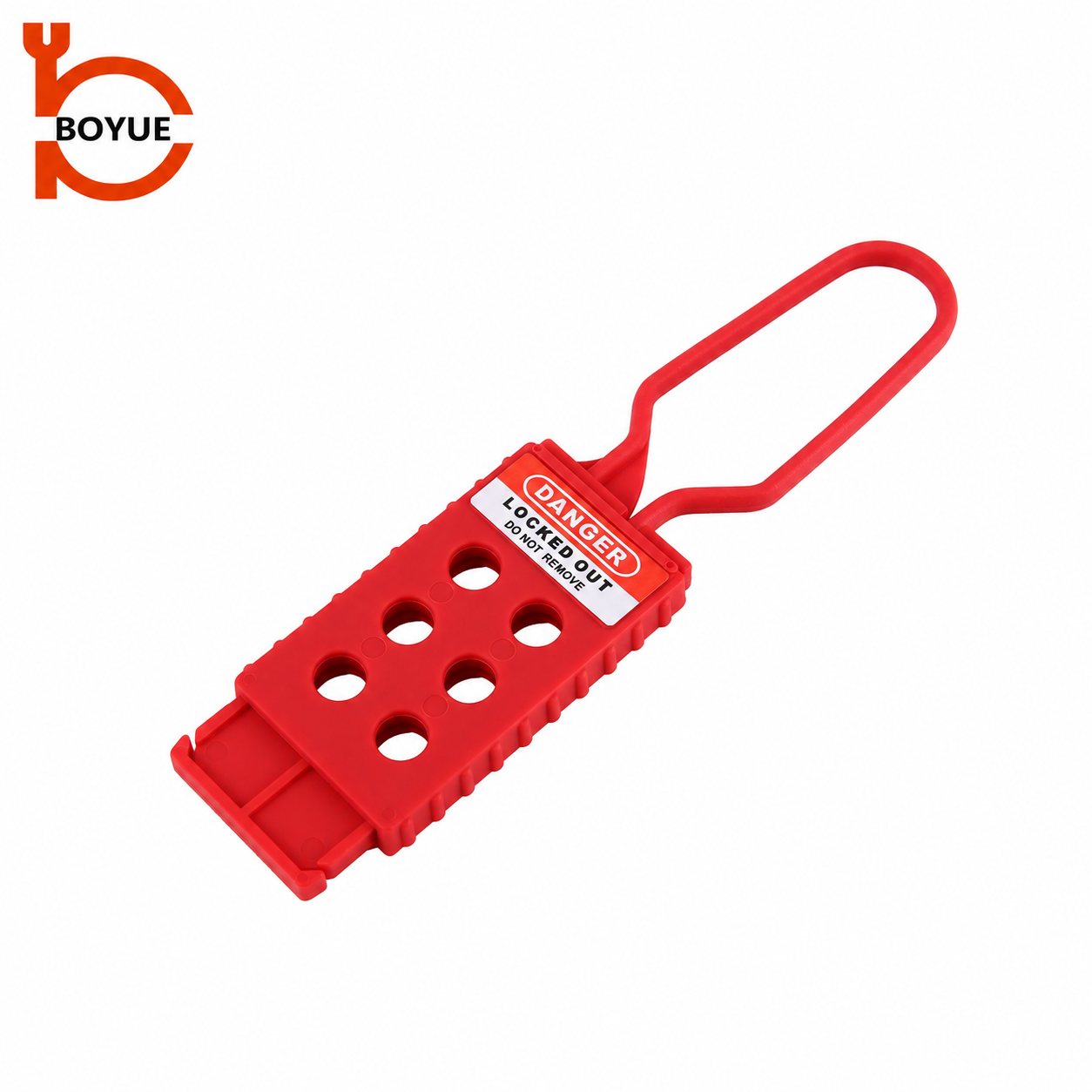
The HN-01 polymer-style hasp has a visibly different long-loop and sliding-body arrangement. Its current product page uses different material descriptions in different sections. Ask for the exact supplied polymer and current instructions before specifying chemical or temperature performance. Do not translate the product name into an electrical withstand, arc-flash or hazardous-area certification.
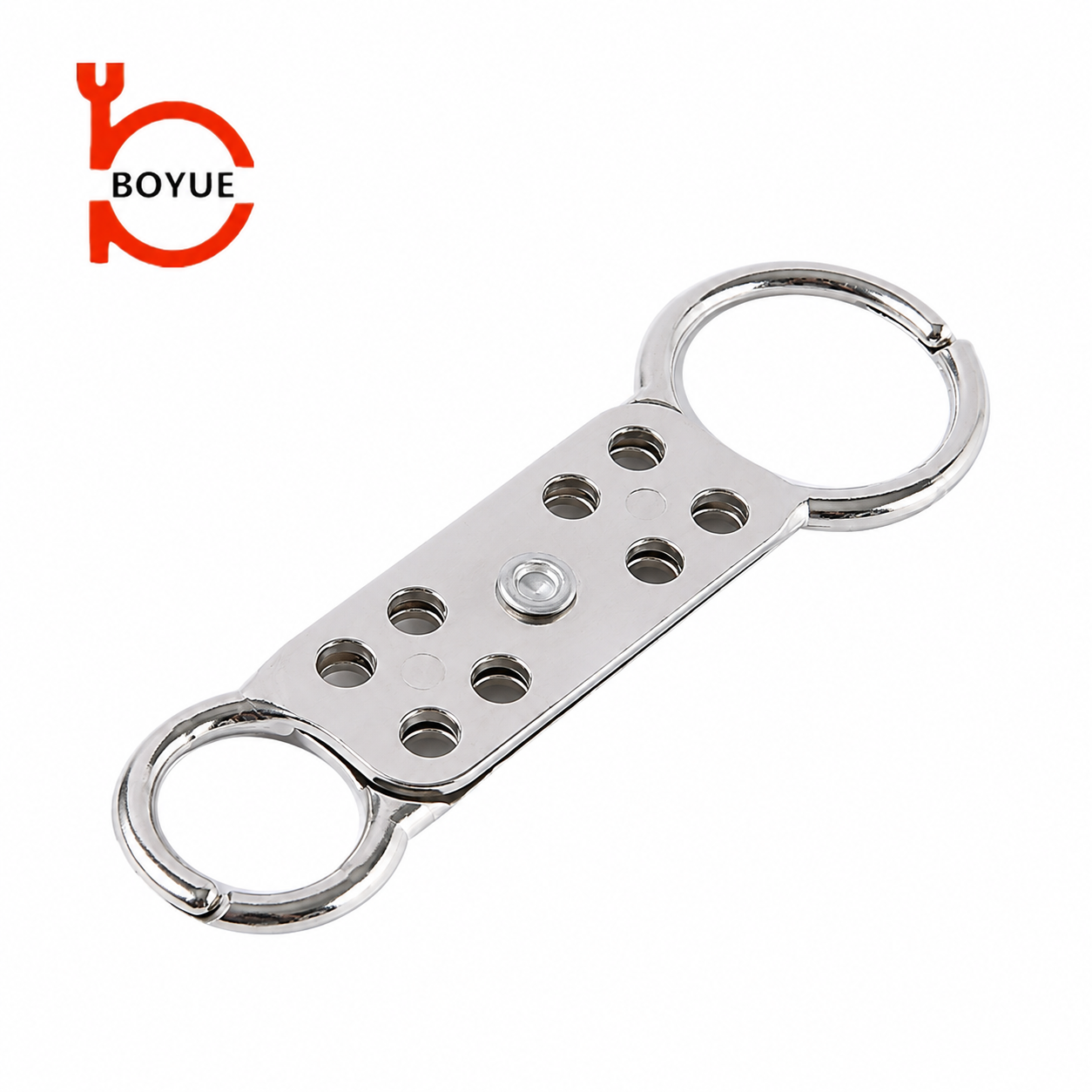
The DHA-01 double-end hasp offers two differently sized ends in the pictured design. Confirm which end is approved for the intended connection and how its locking positions work. Two ends do not, by themselves, prove that the accessory is approved to secure two separate isolation points at once.
Test padlock compatibility with the complete set
Bring the actual personal padlocks to the sample assessment. Shackle diameter determines whether the shackle enters a hole, but usable shackle height and width determine whether it can close. Padlock-body size controls how several locks hang together. Tags and identification accessories can also crowd the area around the locking section.
Fit the required locks in their intended positions and check access individually. A worker should not need to remove somebody else’s lock to add or remove their own under the approved sequence. Check that a hanging body does not act as a lever against a vulnerable part or hide the closure from inspection. The acceptance record should identify the padlock model as well as the hasp model.
Also assess the relevant remaining-lock conditions. The arrangement must preserve the required protection when other workers have removed their locks and a required personal lock remains. Do not assume a test with every hole filled proves all permitted positions. Have the responsible authorized person determine the appropriate checks without introducing exposure or conducting improvised destructive testing.
Keep usable capacity distinct from the group procedure
A hasp’s physical capacity is only one input to planning. Determine the likely number of people, including contractors and overlapping shifts, then establish how each person’s protection is maintained. If the planned crew exceeds the usable capacity, select an approved alternative arrangement. Do not add a chain of accessories simply to create more holes without checking retention, identification and access.
Under the US general-industry provisions of OSHA 29 CFR 1910.147, group lockout includes personal protection requirements for authorized employees. The same standard addresses durable, standardized and substantial devices. These are programme requirements within that regulation’s scope; a product photograph or an unspecified compliance label does not demonstrate that an installation meets them.
Keep key-system decisions separate from physical hole capacity. A shared key arrangement can undermine the intended control even where every lock fits. Review KA, KD and master-key selection with the programme owner. Where a cable device is involved, confirm that the hasp is an approved interface for that specific mechanism rather than relying on a visually convenient opening.
Inspect the closure, pivot and locking holes
Before use, check that the jaw or loop has not bent, cracked or spread. Look for corrosion, sharp damage and abnormal gaps. Examine the pivot and overlapping ends for looseness or distortion. On a sliding design, confirm the parts move and engage as the instructions require. A device that closes only when squeezed out of shape should be removed from service for assessment.
Inspect every intended locking hole, including the surrounding material. Distortion, cracks or excessive wear can affect retention even when a padlock still passes through. Check the handle cover and identification surfaces, but do not let a tidy appearance distract from damaged structural parts. Never straighten, weld or drill a hasp to restore it unless the manufacturer provides an approved repair process.
Use the exposure history when deciding what needs closer attention. A device repeatedly used near corrosive cleaning chemicals may need a different specification from one stored indoors. Follow the manufacturer’s cleaning and storage instructions and the site’s inspection arrangements. There is no universal replacement interval that can be selected from colour, material name or price alone.
Build a sample approval and reorder record
Start with an application sheet containing the isolation-point identifier, photographs, locking-eye dimensions, jaw clearance, required safe position and available working space. Add the personal-padlock model, maximum simultaneous users and expected environment. Request a current drawing, material declaration and fitting instructions tied to the exact proposed hasp model.
Approve a sample before committing to a large order where compatibility is uncertain. Record which jaw or end was used, how the body sits, and whether the full personal-lock set was checked. Retain photographs of the accepted arrangement. A supplier change to the pivot, hole spacing or jaw shape should trigger the relevant reassessment even if the sales name stays the same.
On delivery, compare the batch against that approved record. Check product markings and visible geometry as well as quantity. Separate damaged or inconsistent items before distribution. Keep the approved model identifier in the purchasing system so future orders do not replace a checked design with an untested alternative based only on the phrase lockout hasp.
Further learning: fit checks support a wider programme
NIOSH’s hazardous energy control resources place locking hardware within the broader prevention of unexpected energy release. The SAFE Work Manitoba video below provides introductory context. It does not certify a particular hasp or replace model-specific fitting instructions.
Watch Lock Out Procedures by SAFE Work Manitoba on YouTube.
Frequently asked questions
Does a six-hole hasp always accommodate six workers?
Not automatically. Check the exact approved arrangement, all personal padlocks, tag clearance and simultaneous access. Visible hole count is not proof of usable capacity for every lock combination.
Is a polymer hasp automatically suitable for electrical work?
No. Confirm the exact construction and any documented ratings required for the intended use. Product names and colour do not establish electrical protection or permission to work on energized equipment.
Can a double-end hasp secure two isolation points together?
Do not assume so. Follow the model’s instructions and the approved application assessment. Two jaw sizes may provide alternative fit options rather than an approved two-point locking arrangement.
When should a lockout hasp be removed from service?
Remove a suspect device when its jaw, pivot, closure or locking holes are damaged or unreliable. Follow the site’s assessment and manufacturer guidance before reuse; do not improvise structural repairs.