Lockout Tagout Kit Selection: Build a Verified Equipment List
Choose a lockout tagout kit by matching its individual devices to the equipment your team must isolate, not by selecting the largest advertised piece count. Start with an approved isolation-point list, confirm each required device and personal padlock, then specify quantities, identification, storage and replacement parts. A useful kit is a checked assortment for a defined job scope. A full toolbox alone does not establish that the equipment can be isolated safely.
This guide explains how maintenance buyers can turn an equipment survey into an order that can be verified on delivery. Explore the BOYUE lockout kit range after defining the intended work. This is purchasing guidance, not a machine-specific isolation procedure.
Define the equipment and work covered by the kit
Begin with the machines, work areas and maintenance tasks that the proposed kit will support. A personal kit for an electrician travelling between approved panels has a different scope from a shared maintenance toolbox covering valves, plug connections and mechanical equipment. Write down that scope before choosing a stock assortment. Exclude jobs that need specialist arrangements the kit has not been assessed to provide.
Ask the responsible authorized person to identify the isolation points using the site’s equipment-specific instructions. Record each point’s identifier and the required safe position. Do not assume that a stop button or an operating selector is the energy-isolating device. The CCOHS lockout guidance explains this distinction and the need for equipment-specific instructions.
Keep a list of unresolved points. If a handle, locking eye or connection has not been inspected, mark it as awaiting assessment rather than assigning a generic universal device. This makes gaps visible before purchase and prevents a buyer from treating an untested accessory as a solution merely because it appears in the kit photograph.
Build an isolation-point-to-device matrix
Create one purchasing line for each required device configuration, linked back to the relevant equipment points. Include the accepted model or the information needed to select a sample. For breakers, note the actual mechanism and access. For valves, record handle or wheel geometry and nearby obstructions. For plug enclosures, record the full plug envelope and cord exit.
| Equipment requirement | Kit purchasing entry | Evidence before acceptance |
|---|---|---|
| A disconnect or breaker must remain in its approved position | Specific compatible lockout device and personal lock | Exact sample fits and cannot release through the permitted assessment |
| A valve operating part requires restraint | Approved valve device or cable arrangement | Required position, clearance and routing checked on the actual point |
| A plug must be enclosed under the procedure | Enclosure sized for the plug and cord | Enclosure closes, cable exit fits and locking prevents access |
| Several authorized people need personal protection | Compatible personal locks and approved group accessories | Usable simultaneous capacity and responsibilities established |
| Items are consumed or frequently replaced | Tags and approved attachment supplies as separate reorder lines | Correct format, identification and replacement source recorded |
This table is a qualitative planning framework. It does not provide universal dimensions, test forces or a regulatory minimum kit quantity. Those details depend on the equipment, selected products and applicable programme.
Compare a stock assortment against the matrix
The GLC-03 electrical lockout tagout kit is one possible starting assortment. Its current page lists a toolbox, padlocks, hasps, breaker devices, a cable device, valve devices and tags. Treat the published list as a starting point for a quotation, not as proof that each item fits your equipment. Request an itemized list tied to the exact offered configuration.
Other BOYUE kit configurations use different containers and component quantities. Compare them line by line rather than relying on a group, electrical or personal label. If the photograph and written list disagree, ask which configuration will be supplied and resolve the difference before ordering. An illustration helps identify a product family; it cannot establish delivered quantities or measurements.
Keep three columns in the comparison: included and approved, included but not yet approved, and required but missing. Only the first column represents established coverage. This is more useful than a percentage based on the number of accessories, because one missing device at a critical isolation point can matter more than several spare tags.
Separate personal padlocks from shared accessories
Personal lock requirements depend on the approved work arrangement and the people involved. Establish ownership, identification and key control before buying locks in bulk. Shared tools and accessories can be stored together, but that does not make personal keys shared resources. For the keying decision, use the separate guide to safety padlock keying systems.
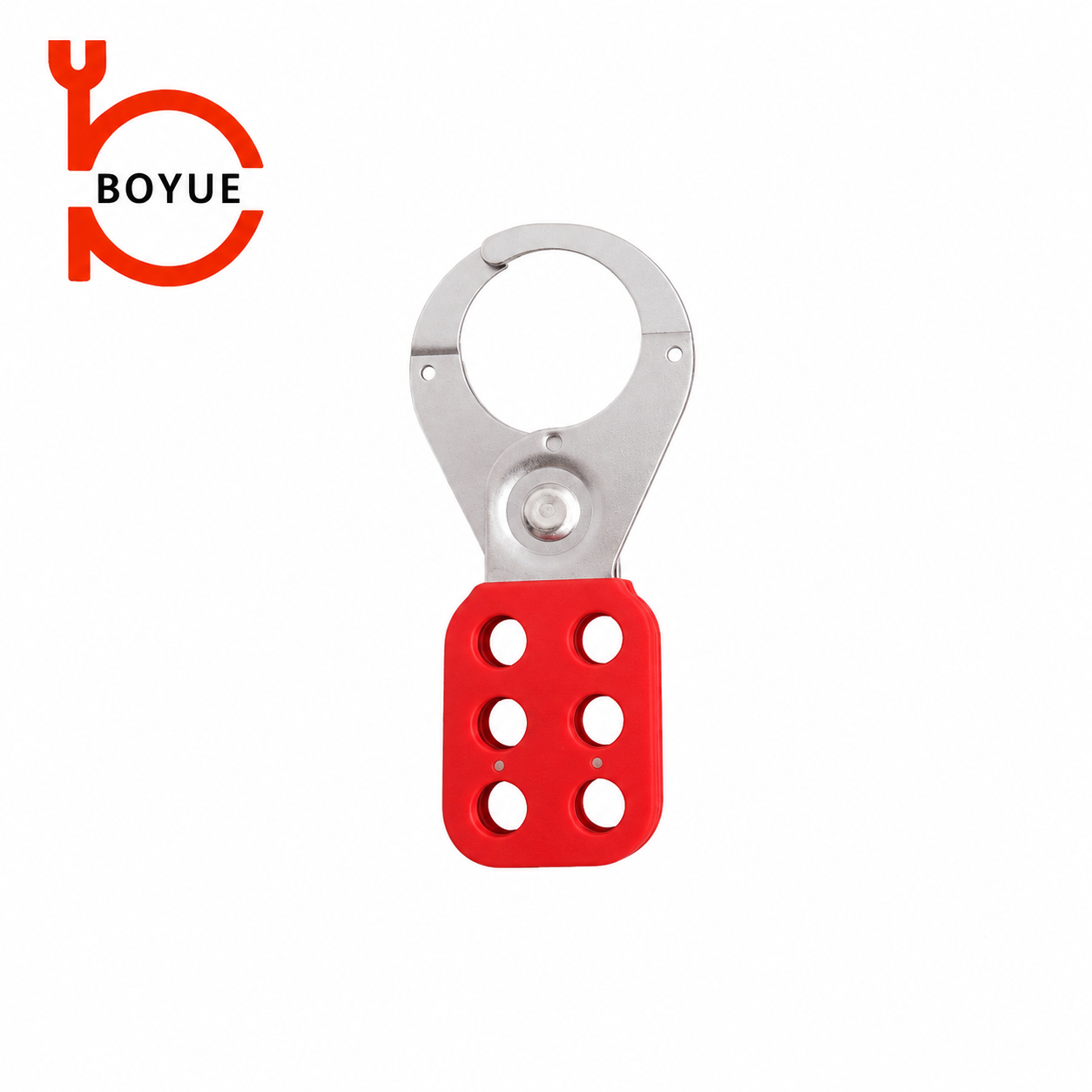
Check hasps with the actual proposed locks. Hole diameter alone does not establish whether a padlock will close or whether several lock bodies interfere. The HS-01 and HS-02 steel hasp family illustrates why jaw size and personal-lock clearance are separate purchasing checks. A compatible hasp must also fit the intended isolation point.
A kit marketed for groups does not define the site’s group procedure. Determine crew coordination, protection during personnel changes and how each authorized person’s protection is maintained. The existing group lockout box procedure guide covers that management question separately from the contents of this toolbox.
Approve difficult device interfaces before batch purchase
Give priority to points where geometry or access is uncertain. Obtain the exact device variant and assess it on equipment already made safe under the site’s rules. A catalogue description such as adjustable does not mean the device fits every opening, handle or locking eye. Record the padlock used in the assessment, because shackle and body dimensions affect the assembled fit.
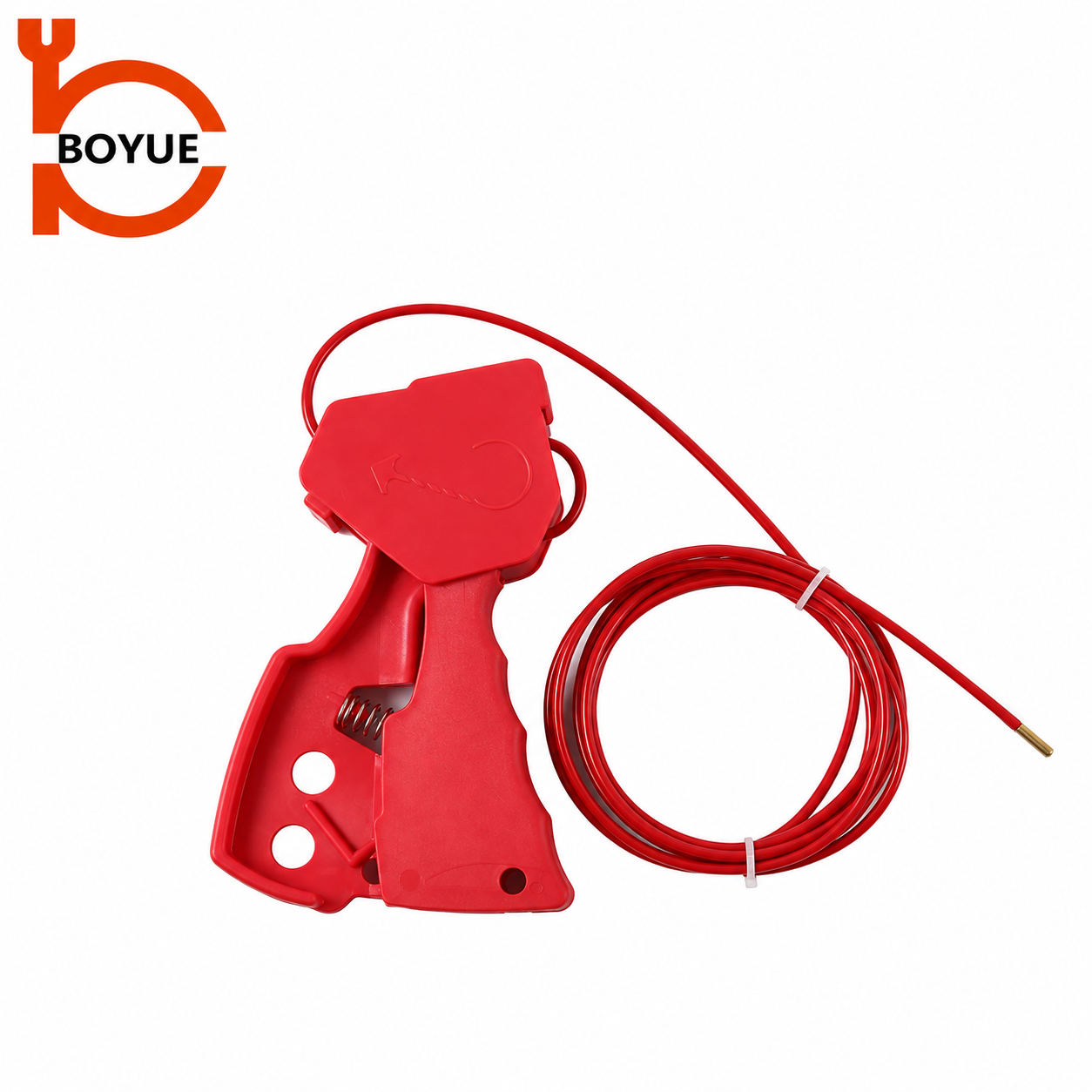
For a cable accessory, confirm the complete route, fixed anchor, free-end clearance and residual movement. The AC-02 cable lockout is a separate device with its own mechanism and fitting requirements. Its presence in a kit does not prove that a proposed route is acceptable. Refer to the cable lockout selection guide for those checks.
Do not modify devices to make the kit fit. Drilling a locking hole, cutting a cable end or reshaping a jaw changes the configuration being assessed. Record a failed fit as a device-selection problem and request an approved alternative. Keep the sample approval record available for later purchases so a substituted part is not accepted solely on a familiar name.
Set quantities for concurrent work and replenishment
Estimate simultaneous demand from the planned work, rather than the total number of machines in the plant. A device left on one active isolation is unavailable for another job. Personal locks may also be committed across several isolation points or a group arrangement. Have the programme owner confirm the required protection before translating the workload into an order quantity.
Separate durable devices from consumable supplies. Record tags and other approved consumables as individual reorder lines. Establish stock levels from actual usage and replenishment time; there is no universal spare percentage suitable for every workshop. Keep replacement stock separate from items assigned to active work so a full-looking box does not conceal a shortage.
When evaluating price, compare an accepted configuration with an accepted configuration. Include missing device types, extra personal locks, replacement availability and the container needed to carry the load. An inexpensive assortment can require substantial additions before it covers the defined work scope.
Specify identification and the container as purchasing requirements
Give the kit a controlled identifier and retain its current contents list. Identify devices and personal locks according to the site’s system without obscuring safety messages or manufacturer information. Confirm the required tag language and writable fields. If custom printing is ordered, approve the exact artwork and wording before production.
Choose storage only after the component list is established. Check that the largest approved item fits, that tags remain readable and that small accessories can be found without emptying the box. The loaded container should close normally and protect parts from the expected handling. Storage appearance does not establish waterproofing, chemical resistance or suitability for a hazardous area.
Assign responsibility for checking completeness before issue and after return. A kit can contain serviceable parts yet be incomplete for its assigned scope. Keep those two checks separate so a passed visual condition check is not mistaken for confirmation that all required devices are present.
Use a receiving checklist that catches substitutions
On delivery, compare model identifiers, quantities, keying arrangements and supplied instructions against the approved order. Inspect visible geometry and markings against retained samples. Where a variant has changed, repeat the relevant fit assessment before distribution. Do not accept an alternative because its colour and general function appear similar.
Record discrepancies and keep unapproved items out of issued kits. After acceptance, save the final component list with the supplier reference and replacement codes. Update it whenever an approved item changes. This turns the kit into a maintainable resource rather than a one-time purchase whose contents become uncertain after the first few jobs.
Further learning: a kit supports the energy-control programme
NIOSH’s hazardous energy control resources explain the wider need to address different energy sources through a planned programme. The SAFE Work Manitoba video below introduces the lockout process. It is general education and does not demonstrate or certify the contents of a BOYUE kit.
Watch Lock Out Procedures by SAFE Work Manitoba on YouTube.
Frequently asked questions
Is a higher piece-count lockout kit always better?
No. Compare the approved device types and usable quantities against the equipment and concurrent work. Extra tags or duplicate accessories do not compensate for a missing compatible lockout device.
Can one standard kit cover every machine?
Only if its exact devices have been assessed for the defined equipment scope. Unchecked isolation points remain gaps even when the kit is described as universal or comprehensive.
Does buying a lockout tagout kit establish compliance?
No. Hardware selection is one part of the applicable energy-control programme. Procedures, responsibilities, training, verification and other requirements must be addressed for the actual workplace.
What should the purchase order specify?
Specify the approved component models and quantities, personal-lock keying and identification, container, instructions, accepted samples and replacement codes. Resolve differences between photographs and written lists before ordering.